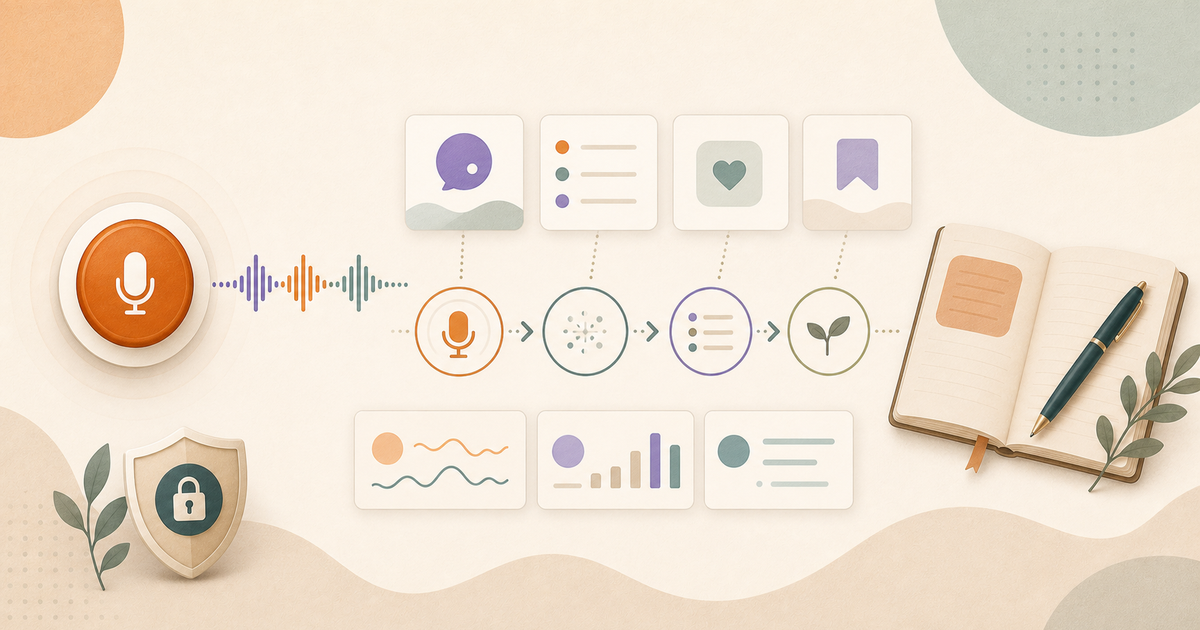
Voice Journal vs Text Journal: Which Is Better for You?
Voice is 3x faster and captures emotion. Text is better for reflection and editing. Here's exactly when to use each method for maximum benefit.
You want to journal consistently. But should you speak your journal or write it?
The answer depends on what you’re journaling for, when you’re journaling, and how your brain prefers to process.
Neither method is universally better. Each has specific strengths. Here’s exactly when to use which.
The fundamental differences
Speed: 150 words per minute vs 40
You speak at roughly 150 words per minute. Even talking slowly, you’re around 120 words per minute.
You type at 40 words per minute. Fast typists reach 60-80. Handwriting is even slower at 20-30 words per minute.
This 3-4x speed advantage for voice means:
- Voice captures thoughts at the speed you think them
- Writing slows thought to output speed
Whether this is an advantage or disadvantage depends on your goal.
Emotional authenticity vs reflection
Voice carries emotional information through tone, pace, emphasis, and inflection. When you listen back, you don’t just know what you were thinking—you hear how you were feeling.
Your hesitation is audible. Your enthusiasm comes through. Your frustration is obvious in delivery even when your words stay neutral.
Writing flattens emotional information into uniform text. But this flattening creates distance that allows deeper reflection. You’re processing emotions rather than being immersed in them.
Accessibility vs editability
Voice works anywhere: while walking, driving, in bed, during shower. You just need privacy and your phone.
Writing requires sitting (or at least stopping movement), lighting, a physical or digital writing surface, and sustained attention.
But what writing lacks in accessibility, it gains in editability. You can revise as you go. Delete unclear thoughts. Organize while creating.
Voice is linear. Once spoken, words exist. You can’t unspeak them or reorganize mid-sentence.
Voice journaling strengths
When emotions are running high
During acute stress, anxiety, or overwhelm, voice processing provides faster relief than writing.
Speaking your emotions aloud can activate regulatory brain pathways that reduce intensity. Research on naming emotions (affect labeling) links emotional labels with lower amygdala activity during emotional tasks.
Writing the same emotions requires more cognitive control—organizing sentences, choosing words, maintaining coherence. When you’re overwhelmed, this additional control is depleting rather than helpful.
Use voice when: You need immediate emotional release and regulation.
For capturing ideas in motion
Your best ideas don’t arrive at your desk. They arrive during walks, showers, commutes, or the transition between sleep and wake.
Voice notes capture these ideas the moment they appear. Writing requires stopping movement and finding a writing surface, during which many ideas evaporate.
Use voice when: You’re moving or in situations where writing is physically impractical.
For verbal processors
Research suggests 30-40% of people are verbal processors—they think best by speaking rather than writing or internal thought.
If you’re in this group, voice journaling isn’t just easier. It’s how your brain naturally achieves clarity. Externalizing through voice creates the conditions for your best thinking.
Use voice when: Speaking is your primary processing mode.
For overcoming writing resistance
Many people struggle with journaling consistency because writing feels like work. The blank page creates pressure. Grammar and organization requirements add friction.
Voice journaling removes these barriers. Press record. Talk. Done. The ease makes consistency achievable.
Use voice when: Writing friction prevents you from journaling at all.
For morning brain dumps
Starting your day with a voice brain dump externalizes everything on your mind before tackling work.
Speaking is faster than writing, so you spend less time dumping and more time doing. The speed advantage is particularly valuable for morning routines when time is limited.
Use voice when: You need fast mental clearing without extensive time investment.
Text journaling strengths
For deep reflection and analysis
Writing creates space between thought and expression. You can pause, consider, revise before committing.
This reflective distance helps you:
- Examine thoughts from multiple angles
- Question assumptions before accepting them
- Explore nuance that speaking might rush past
- Develop complex arguments that require careful construction
Use writing when: You’re reflecting deeply rather than processing emotionally.
For structured frameworks
Some journaling methods require visual structure: gratitude lists, goal frameworks, habit tracking, comparing options in columns.
These are harder to do through voice. Writing provides the visual organization that makes structured practices work.
Use writing when: Your journaling uses specific frameworks or templates.
For future search and review
Text is infinitely easier to skim, search, and review than audio.
Looking for a specific insight from six months ago? Text: search in seconds. Voice: listen through hours of recordings or rely on AI transcription (which may be imperfect).
Use writing when: You plan to reference specific journal entries frequently.
For careful articulation
Sometimes you need precise language. You’re working through a complex decision. You’re drafting thoughts that might become public writing. You’re developing an argument that requires exact phrasing.
Writing lets you craft carefully. You can revise until the language exactly matches your thinking.
Use writing when: Precision matters more than speed.
For public or shared contexts
Sharing insights from your journal, creating content based on journal material, or collaborating with others (therapist, coach, accountability partner) typically requires text.
Voice creates intimacy and privacy. Text creates shareability.
Use writing when: The content might need to be shared or developed into external communication.
When to use both
Many effective journalers use both methods strategically:
Daily voice + weekly written synthesis
- Daily: Quick voice journals (3-5 minutes) for emotional processing and idea capture
- Weekly: Written reflection (20-30 minutes) reviewing patterns, setting intentions, synthesizing insights
Voice handles the daily emotional work. Writing provides the periodic analytical work.
Voice for processing, writing for planning
- Voice: Process emotions, work through problems, externalize worries
- Writing: Set goals, track habits, plan projects, make structured decisions
Voice handles the messy internal work. Writing handles the organized external work.
Voice for capture, writing for development
- Voice: Capture ideas the moment they arrive (shower, walk, commute)
- Writing: Develop the captured ideas into polished form (essays, plans, proposals)
Voice ensures you don’t lose ideas. Writing transforms ideas into finished products.
The decision framework
Ask yourself these questions:
What’s your primary goal?
- Emotional regulation → Voice
- Deep reflection → Writing
- Idea capture → Voice
- Structured planning → Writing
When are you journaling?
- While moving → Voice
- At a desk → Either
- Before bed → Either (but voice avoids blue light)
- First thing waking → Voice (faster, less friction)
What’s your natural processing style?
- Verbal processor → Voice preference
- Visual processor → Writing preference
- Mixed → Use both situationally
How will you review?
- Rarely review → Voice is fine
- Frequent review → Writing or transcribed voice
- Pattern analysis → Writing or AI-analyzed voice
What’s your consistency challenge?
- Writing feels like homework → Voice
- Can’t find privacy to speak → Writing
- Both feel effortful → Start with voice (lower barrier)
The hybrid approach
The most effective journaling practice for many people:
Morning (2-3 minutes): Voice brain dump while making coffee. Externalize everything on your mind to start the day clear.
Throughout day (as needed): Quick voice notes for ideas, decisions, emotional moments. Capture in the moment without disrupting flow.
Evening (5 minutes): Voice processing of the day. What happened? How do I feel about it? What’s still on my mind?
Weekly (20 minutes): Written reflection. Review voice journal patterns. Set intentions. Track progress on goals.
This approach gets you:
- Daily emotional regulation (voice)
- Idea preservation (voice)
- Pattern recognition (reviewing voice)
- Structured planning (writing)
- Consistency (voice’s low friction makes daily practice sustainable)
The tools matter less than you think
For voice:
- Phone voice memos (free, private, simple)
- Voice journaling apps (transcription, AI insights)
- Dictation software (real-time speech-to-text)
For writing:
- Physical notebook (no distractions, no battery, personal)
- Notes app (searchable, always available, syncs across devices)
- Journaling app (structure, prompts, privacy features)
The best tool is the one you’ll actually use consistently. Don’t optimize tools before establishing the practice.
Common mistakes
Using voice when you need structure
Voice is poor for:
- Comparing options in table format
- Creating organized lists
- Tracking metrics over time
- Visual planning
If your practice needs structure, use writing or hybrid (voice capture → text organization).
Using writing when you need speed
Writing is poor for:
- Quick emotional release
- Capturing fleeting ideas
- Morning brain dumps when time is limited
- Processing while moving
If speed or accessibility is critical, voice wins.
Thinking you must choose one
The most effective approach is often using both methods for their respective strengths. You’re not choosing a side. You’re using the right tool for the specific job.
The bottom line
Voice journaling is faster (3x speed), captures emotional nuance, and works anywhere. Writing is better for reflection, visual organization, and precise articulation.
Neither is universally superior. The best method depends on:
- What you’re journaling for (emotional processing vs analytical reflection)
- When and where you’re journaling (moving vs sitting, morning vs evening)
- How your brain processes (verbal vs visual preference)
- Whether you’ll review later (search and skim vs pattern listening)
Most effective journalers use both strategically: voice for daily emotional work and idea capture, writing for weekly synthesis and structured planning.
Start with whatever method has less friction for you personally. Consistency matters more than method. You can always add the other approach once the habit is established.
The best journal is the one you actually use.
Questions people ask
Is voice journaling better than writing?
Neither is universally better. Voice is 3x faster, captures emotional nuance, and works while moving. Writing is better for careful reflection, visual organization, and editing. Many people use both.
What are the disadvantages of voice journaling?
Voice journaling requires privacy to speak aloud, is harder to skim than text, and captures less visual structure. It's also challenging in quiet public spaces where speaking isn't socially appropriate.
Can I combine voice and text journaling?
Yes. Many people use voice for daily emotional processing and idea capture, then use writing for deeper reflection, goal-setting, and organizing insights. The methods complement each other.
Which journaling method is best for anxiety?
Voice journaling is often more effective for acute anxiety because speaking interrupts rumination loops and activates regulatory brain pathways faster than writing. Text works well for structured anxiety management techniques.