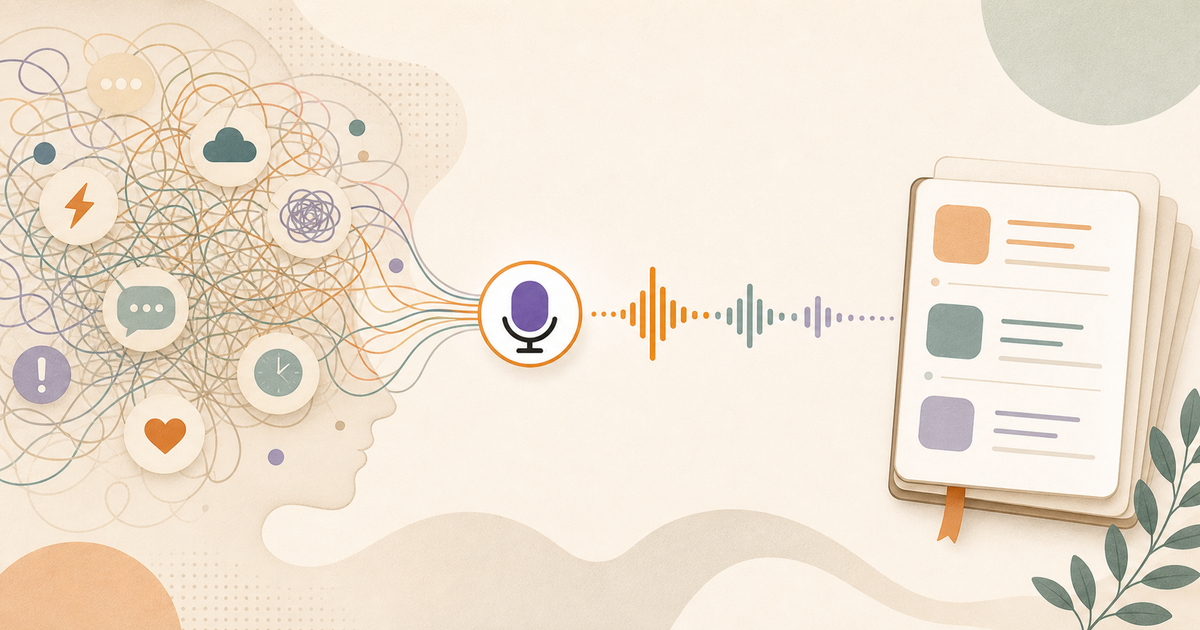
Why Your Thoughts Feel Louder in Silence
Silence can help some people calm down, but for overthinkers it often removes the distractions that were keeping thought loops quiet.
Quiet is supposed to feel peaceful.
For some people, it does. They sit in silence and their nervous system settles. Their thoughts slow down. Their body gets the signal that nothing urgent is happening.
For other people, silence makes thoughts louder.
The moment the room gets quiet, the brain starts talking: the mistake from earlier, the email you have not answered, the bill you forgot, the thing your partner said, the vague fear that you are behind in life.
This does not mean silence is bad. It means silence removes competition.
Your Brain Uses Quiet To Surface Open Loops
During the day, your attention is crowded. Work, messages, errands, noise, people, screens, and deadlines all compete with internal thought.
When everything gets quiet, the competition drops.
Unfinished mental material moves forward.
The Zeigarnik effect explains part of this. Incomplete tasks and unresolved thoughts stay more active in memory than completed ones. Your brain keeps them warm because it does not want you to forget.
At night, in the shower, on a walk, or during meditation, those unfinished items finally get room.
That can be useful. It can also become a loop.
Quiet Reflection vs Rumination
Quiet reflection has movement. You notice a thought, understand something, make a plan, or let the emotion pass through.
Rumination repeats. The thought comes back with the same emotional charge and no new information.
Research on rumination shows that repetitive, passive thinking about distress tends to make people feel worse. The mind feels busy, but the processing is not resolving.
This is why “sit with your thoughts” is incomplete advice.
Some thoughts need quiet.
Some thoughts need language.
Voice Gives The Loop Somewhere To Go
When a thought keeps repeating silently, try saying it out loud.
“I keep thinking about the meeting because I am worried I sounded unprepared.”
Now the thought has edges. You can hear it. You can ask what it wants.
Maybe it wants a plan: “Tomorrow I will send the follow-up note.”
Maybe it wants reassurance: “I was not perfect, but the meeting was fine.”
Maybe it wants acknowledgment: “I felt embarrassed, and that feeling is still moving through me.”
The goal is not to force calm. The goal is to stop letting the same sentence ricochet around your head without being processed.
The Three-Sentence Quiet Reset
When silence starts amplifying your thoughts, record a short voice note:
- “The thought getting loud is…”
- “I think it is asking for…”
- “The next thing I can do is…”
If there is no action, say that too:
“There is nothing to do tonight. This is just leftover stress.”
That sentence is often enough to reduce the urgency.
Why Lound Helps Over Time
One quiet spiral is hard to interpret. Ten quiet spirals become a pattern.
Lound can help you notice whether your loudest thoughts appear at night, after conflict, before work, after too much scrolling, or when you are physically depleted.
That pattern matters because the solution changes.
Night spirals may need earlier processing. Work spirals may need clearer closure. Relationship spirals may need a conversation. Depletion spirals may need rest, not analysis.
Silence is not the enemy. But if silence keeps becoming a stage for the same thoughts, try giving those thoughts a voice.
Questions people ask
Why do my thoughts get louder when it is quiet?
When external stimulation drops, unresolved thoughts have less competition for attention. Your brain may use the quiet to surface unfinished tasks, worries, and emotional material that were suppressed during the day.
Does silence make anxiety worse?
Silence can help some people regulate, but it can make anxiety worse when it turns into rumination. If quiet time becomes repetitive mental replay, externalizing thoughts through speech can help interrupt the loop.
What should I do when quiet makes me overthink?
Try a short voice dump. Name the thought, say what it wants from you, and decide whether it needs action, a plan, or simple acknowledgment.