Is Digital Journaling Private?
Digital journals can protect you from snooping, but privacy depends on locks, exports, encryption, cloud storage, and AI processing.
Digital journaling privacy depends on what you are afraid of.
If the risk is a family member reading your notebook, a locked app can be much safer than paper.
If the risk is cloud storage, AI processing, legal access, or a company you do not trust, paper may feel safer.
Both concerns are valid.
Paper Privacy Is Physical
A paper journal is offline. That is its strength.
No server can be breached. No AI model processes it. No app company can change its terms.
But paper has a simple weakness: anyone who finds it can read it.
That matters for people who live with parents, roommates, partners, siblings, or anyone who might snoop. A notebook in a drawer is not a security system.
Digital Privacy Has Layers
A digital journal can add layers:
- phone passcode
- biometric lock
- app login
- account password
- cloud account security
- app-level deletion controls
Those layers can protect you from nearby people. They do not automatically protect you from every digital risk.
To judge a journal app, ask:
- Is my data stored locally or in the cloud?
- Are entries encrypted in transit?
- Are entries encrypted at rest?
- Is there end-to-end encryption?
- Can staff access content for support or debugging?
- Does AI process my entries?
- Can I export and delete my data?
If the app cannot answer those questions clearly, that is the answer.
Encryption Is Not One Thing
People often say they want encryption, but there are different levels.
Encryption in transit means data is protected as it moves between your device and servers.
Encryption at rest means stored data is encrypted on the server.
End-to-end encryption means the service provider cannot read your content because only your devices hold the keys.
End-to-end encryption is strongest for privacy, but it makes AI features harder. If an app analyzes your entries in the cloud, the content usually has to be readable by the processing system at some point.
That tradeoff should be stated plainly.
AI Adds a Privacy Question
AI journaling apps need extra scrutiny because your entries may be sent to AI providers for transcription, summarization, pattern detection, or chat.
That does not make them bad. It does mean you should know what is happening.
A trustworthy AI journal should explain:
- what gets processed
- which kinds of providers are involved
- whether audio is stored
- whether transcripts are retained
- how deletion works
- whether your content trains public models
For more detail, read AI journaling privacy: what apps do with your data.
Where Lound Stands
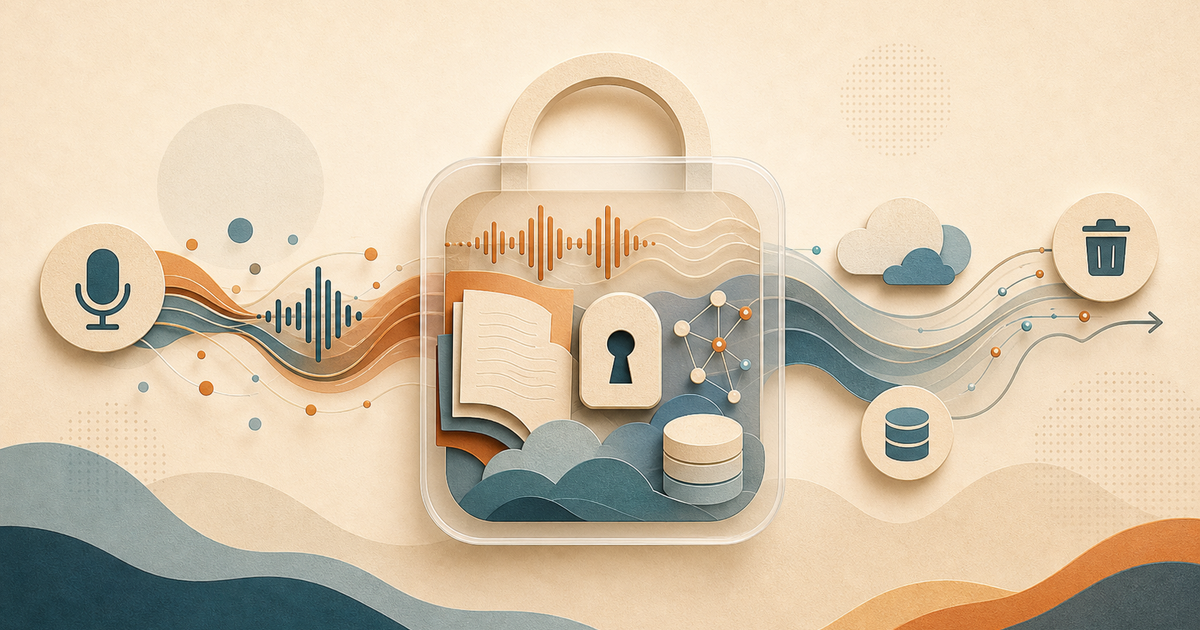
Lound is built around talking, so here is the data flow in plain terms. Your recording is sent for transcription and then to an AI provider to turn it into an entry (title, summary, mood, themes) and, later, to spot patterns and answer questions about your history. Lound does not keep your audio on its servers. If you want to listen back, you can opt in to saving recordings on your phone, and only there. Photos you attach to entries stay in your photo library and are never uploaded. Your entries are not used to train AI models.
Data is encrypted in transit and stored on Lound’s servers, but it is not end-to-end encrypted, and processing happens in the cloud rather than on your phone. That is the tradeoff that makes the transcription, patterns, and chat possible, and it is stated plainly rather than dressed up.
On the control side: you can lock the app with a PIN and Face ID, export your entries and chats as JSON, delete any entry, or delete your account and everything on the server with it.
The Bottom Line
Digital journaling can be private, especially if your main concern is people near you reading your notebook.
For deeper privacy, look past marketing language. Check the actual data flow, encryption model, AI processing, export options, and deletion controls.
A private journal should make honesty feel safer, not more complicated.
Keep reading
For a stronger foundation, read AI Journaling Privacy: What Apps Do With Your Data. For a nearby angle, continue with Hybrid Journaling: Keep Paper, Add Digital Where It Helps.
Questions people ask
Is digital journaling private?
It can be private, but it depends on the app. Look for clear answers about account security, cloud storage, encryption, AI processing, deletion, and export.
Is a digital journal safer than a paper journal?
A digital journal can be safer from people nearby because it can be locked. Paper can feel safer from cloud or AI processing because it stays offline.
Should a journal app have end-to-end encryption?
End-to-end encryption is valuable for highly sensitive journaling, but it can limit AI features. If an app does not offer it, it should say that plainly.