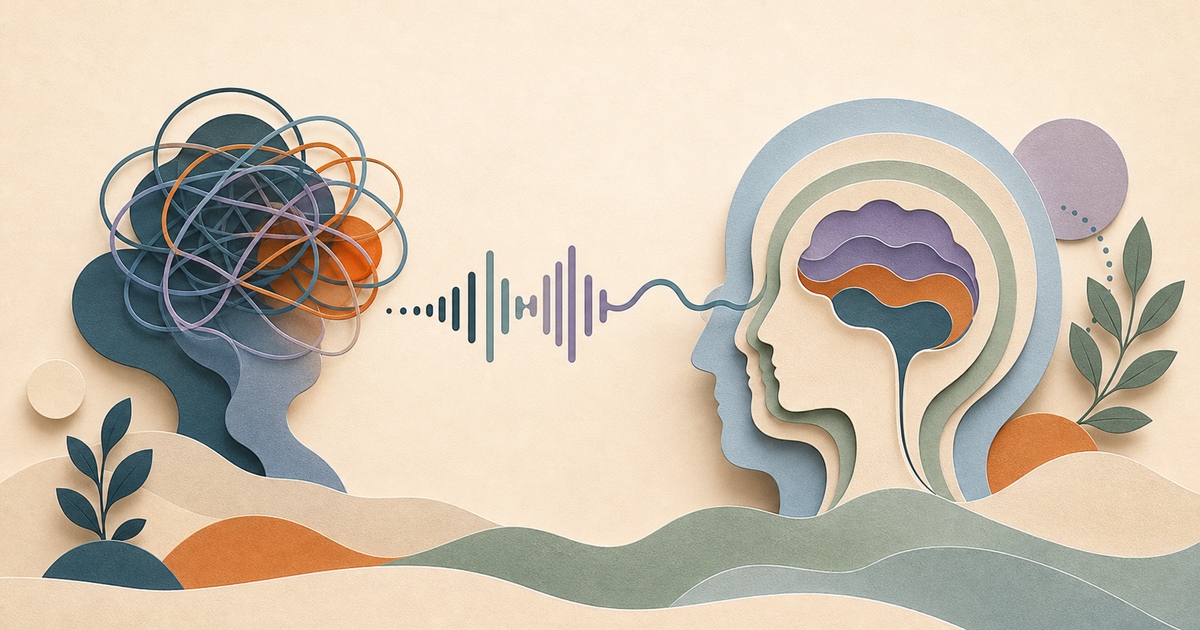
Voice Journaling vs Meditation: Which One Works Better?
Meditation helps you observe thoughts. Voice journaling helps you process them. The better choice depends on what your mind needs.
Voice journaling and meditation are often treated like they solve the same problem. They do not.
Meditation helps you observe thoughts. Voice journaling helps you process thoughts.
That difference matters. If your mind is noisy, meditation may teach you to sit with the noise without obeying it. Voice journaling gives the noise somewhere to go so you can hear what it is trying to say.
Neither is better for everyone. The better tool depends on what kind of mental state you are in.
Meditation Trains Observation
Meditation usually asks you to notice thoughts, sensations, and emotions without immediately reacting. You might focus on the breath, return when distracted, and practice letting thoughts pass.
That is powerful when your problem is reactivity. You learn that a thought can appear without becoming a command.
“I am going to fail” becomes a thought you are noticing, not a fact you must solve right now.
Over time, that can build emotional distance and attention control.
But meditation can feel hard when your mind is packed with unresolved material. Sitting quietly with a loud brain can feel less like peace and more like being locked in a room with every unfinished thought.
For some people, especially during anxiety or grief, silence is not calming at first. It is amplifying.
Voice Journaling Trains Processing
Voice journaling does the opposite. Instead of watching the thought pass, you engage it:
“What is this thought? Where did it come from? What is it asking for? Is it true? What do I need to do next?”
That active processing can be more useful when something is genuinely unresolved.
You are not trying to empty your mind. You are trying to understand what is in it.
This is why voice journaling works well for verbal processors. Some people find clarity by speaking, not by sitting still.
Use Meditation When You Need Space
Meditation is often the better tool when:
- you are reacting too quickly
- you want to build tolerance for discomfort
- you need to stop chasing every thought
- you are practicing attention
- the problem is not urgent, just noisy
Meditation says, “You do not have to follow this thought.”
That can be exactly what you need when your brain is trying to turn every sensation into a project.
Use Voice Journaling When You Need Movement
Voice journaling is often the better tool when:
- the same thought keeps coming back
- you need to make a decision
- you are anxious and need to name the fear
- you are angry and need to hear what is underneath
- writing feels too slow
- you need to prepare for a conversation
Voice journaling says, “Let us find out what this thought is made of.”
That matters when observing the thought is not enough because the thought contains a real need, boundary, decision, or emotion.
If a thought keeps returning, read why the same thought keeps coming back.
The Best Sequence: Speak, Then Sit
For many people, the most practical answer is not voice journaling vs meditation. It is voice journaling before meditation.
Try this:
- Speak for three minutes about what is on your mind.
- Name the main emotion or concern.
- Choose one next step or say, “This can wait.”
- Sit quietly for three minutes.
This works because voice clears the front layer. Meditation then has less clutter to compete with.
You are not using meditation to suppress unresolved thoughts. You are using voice to externalize them first, then giving your nervous system space.
When Meditation Can Backfire
Meditation is useful, but it is not universally soothing. Some people experience more anxiety when they sit quietly with intense internal material. That does not mean they are doing it wrong.
It may mean they need an active processing tool first.
If meditation tends to make your anxiety worse, read why meditation can make anxiety worse. The point is not to reject meditation. The point is to stop treating it as the only respectable way to work with your mind.
When Voice Journaling Can Backfire
Voice journaling can also go wrong if it becomes spoken rumination.
If you talk for 45 minutes and leave more activated, you may be rehearsing the loop rather than processing it. Shorter is often better.
A good voice session should create a little more clarity, relief, or specificity. It does not have to solve everything.
The Bottom Line
Meditation helps you relate differently to thoughts.
Voice journaling helps you understand thoughts by speaking them out loud.
If your mind needs quiet practice, meditate. If your mind needs a place to put what it is carrying, speak.
Both can be useful. The mistake is forcing yourself to use the wrong tool for the moment you are actually in.
Questions people ask
Is voice journaling better than meditation?
Neither is universally better. Meditation helps you observe thoughts without engaging them, while voice journaling helps you process thoughts by speaking them out loud.
Should I voice journal or meditate when anxious?
If silence makes anxiety louder, voice journaling may help first. If you need to practice observing thoughts without reacting, meditation may help.
Can I use voice journaling and meditation together?
Yes. Many people speak first to clear mental clutter, then meditate once their mind feels less crowded.