Why Narrating a Task Out Loud Keeps You Moving
Task narration turns a vague project into a live sequence of visible actions. It works best as a breadcrumb trail, not a motivational speech.
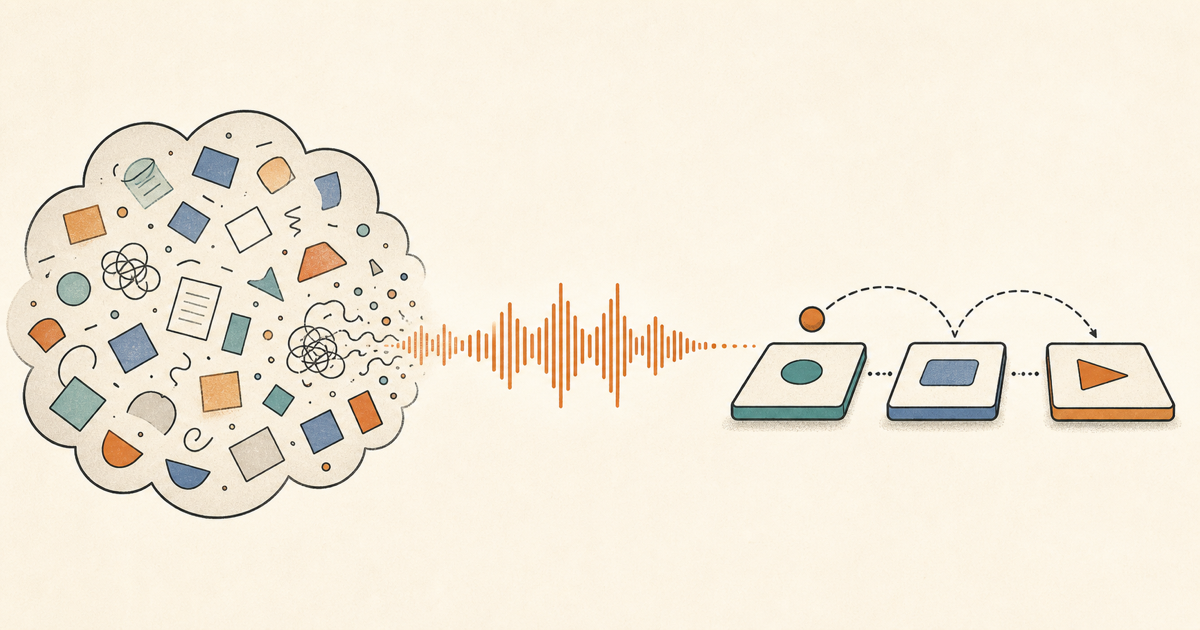
Narrating a task out loud can keep you moving because it turns an abstract goal into a sequence your attention can follow. The useful sentence describes what is happening now and what your hands do next.
Adults naturally use more private speech during difficult and unfamiliar work. Research summarized in a study of adult private speech during complex computer tasks notes that task difficulty, modality, and familiarity all affect how much people talk to themselves. A 2025 study also found that adult language learners used private speech as a scaffold while preparing demanding spoken responses.
The method works because narration provides directions, not because your voice creates magical motivation.
Use breadcrumbs, not commentary
Unhelpful narration evaluates:
“I am behind again. Why is this taking so long? I should be better at this.”
Useful narration guides:
“The spreadsheet is open. I need the June total from the invoice folder. I will find that file, enter one number, and check the formula.”
The second version reduces the distance between the current state and the next physical action.
Use this pattern:
- Current state: “I have the email open.”
- Next action: “I am finding the attachment.”
- Done condition: “This step ends when the PDF is saved in the client folder.”
Then narrate the next step.
Why vague work stalls
“Finish the proposal” names a desired state containing dozens of hidden decisions:
- find the latest brief
- choose the recommendation
- check the numbers
- draft the opening
- create the table
- ask for approval
When the project is represented as one large item, your brain has to choose among all those hidden actions before it can begin. A spoken breadcrumb makes one choice explicit.
This is closely related to using voice for ADHD task initiation, but you do not need ADHD for it to help. The technique is useful whenever the next action keeps disappearing inside the project name.
Narrate at the point of friction
You do not need to talk through every minute. Start when one of these happens:
- you switch tabs without a clear reason
- you reread the same instruction
- you open a project and immediately avoid it
- you cannot tell whether a step is finished
- you have several possible next actions
- an interruption makes you lose your place
Say:
“I stopped at ____. The decision in front of me is ____. The smallest action that creates new information is ____.”
That last clause is especially useful in research and creative work. The next step may be a test, sketch, question, or ugly first paragraph rather than more planning.
When a whole workload feels impossible to enter, use the broader speak-it-to-start method for workload paralysis first, then narrate only the next active task.
Leave a re-entry note
Before a break or context switch, record ten seconds:
“I finished ____. The next action is ____. The file is ____.”
This creates a return address for your attention. When you resume, you do not have to reconstruct the whole session before acting.
If you work alone and struggle more with momentum than clarity, combine this with voice-based body doubling: record the start, one midpoint check, and the stopping point. The journal becomes a light witness without turning the workday into constant self-surveillance.
Know when narration gets in the way
Narration can slow tasks that are already automatic. Talking through each keystroke while touch-typing or each movement while playing a practiced sport can pull attention toward mechanics that normally run without conscious control.
Use it for:
- starting
- choosing
- sequencing
- recovering after interruption
- learning unfamiliar work
Drop it once the task is flowing.
For the cognitive reasons speech can make a thought easier to inspect, read why speaking out loud helps you think.
A five-minute trial
Choose one task you have avoided. Record or say:
“The task name is ____. The actual next action is ____. I will know it is done when ____.”
Work only until that condition is true. Then name the next breadcrumb.
You may discover that the task was not too large. The instruction available to your attention was too vague.
Questions people ask
Why does narrating a task out loud help?
Narration makes the current goal and next action audible, which can help guide attention and expose where a vague task has stalled.
Is talking through tasks normal for adults?
Yes. Research on private speech shows that adults use self-directed speech, especially during unfamiliar, difficult, or cognitively demanding tasks.
What should I say while working?
Describe the current state, the next visible action, and the condition that means the step is done. Keep each sentence concrete.