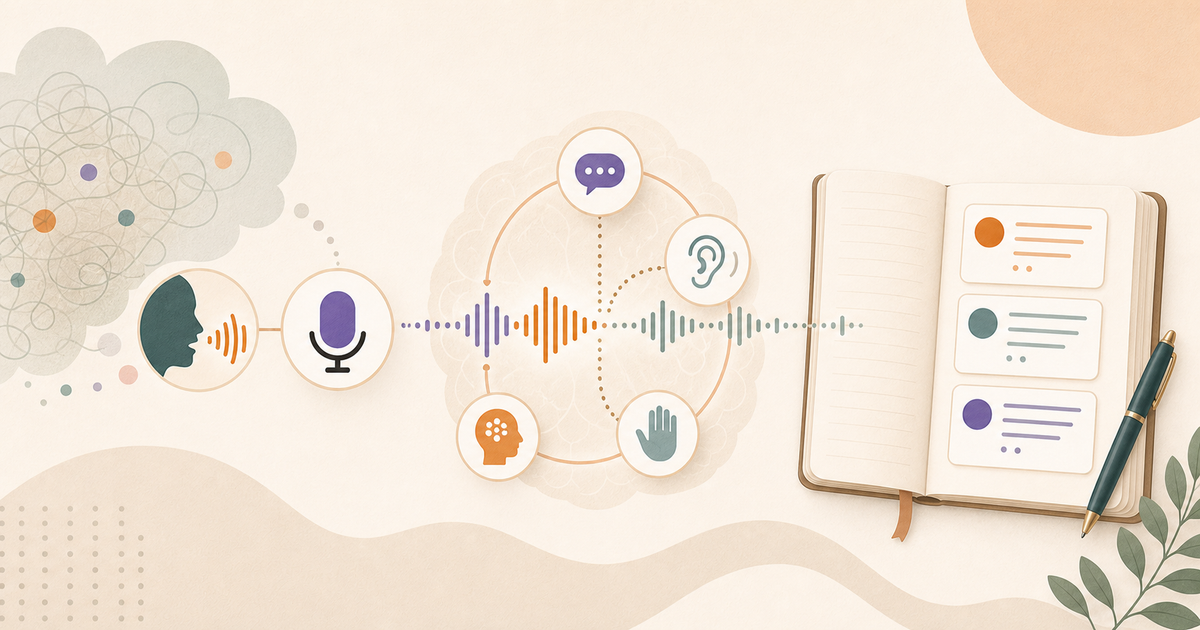
Why Teaching It Out Loud Works
Teaching out loud forces retrieval, connection, and gap detection. That is why self-explanation usually beats passive rereading.

Teaching something out loud works because it forces you to do more than recognize familiar words. You have to retrieve the idea, connect the parts, and say how it fits together in your own language.
That is the core of self-explanation. It is why a clumsy spoken explanation often teaches you more than another silent pass through your notes.
Self-explanation beats passive review
In a classic comparison of learning strategies, self-explanation outperformed both elaborative questioning and simple repetition. Learners did better when they explained what the material meant and how it connected to what they already knew.
Later work found the same basic pattern in different forms. Self-explanation prompts produced learning benefits beyond control practice, and a 2026 replication on worked examples again found that self-explanation quality could help mediate learning gains.
The point is not that talking is magical. The point is that explanation is active.
Recognition is not understanding
Rereading feels productive because the page stays familiar. Familiarity is comforting. It is also a weak test.
You can recognize:
- a formula
- a framework
- a set of terms
- the shape of an argument
without being able to rebuild it from memory.
When you teach the idea out loud, you immediately learn whether the structure actually exists in your head. That is why speaking helps you learn better than rereading alone.
Out loud adds pressure in a useful way
Speaking creates a small amount of productive friction.
You cannot hide behind highlighted lines when you have to say:
- what happens first
- why the step matters
- how one claim leads to the next
- what example proves you understand it
This is also why hearing yourself can catch weak reasoning. The moment your explanation turns vague, you know exactly where the learning work starts.
Teaching forces connection, not just storage
Good explanations do not only repeat facts. They link new material to prior knowledge.
For example:
- not just “implementation intentions help”
- but “they help because a cue is attached to a response, so the action is easier to notice and start”
That linking work is where a lot of learning happens. Self-explanation pushes you to build bridges instead of stacking disconnected facts.
It is one reason the science of speaking your thoughts matters outside emotional processing too.
How to use this in real life
Explanation can serve a different purpose when you already know what to do but haven’t acted. Giving practical advice to someone else has helped advisors’ own motivation in experiments; that research asks about follow-through rather than learning unfamiliar material.
You do not need a classroom. Use a sixty-second explanation test.
Pick one concept and answer:
- What is it?
- How does it work?
- What is one example?
- What part am I least sure about?
If you can answer all four cleanly, you probably know the material. If you stall on number two or four, you found the gap.
That is far more useful than another passive skim.
When this works best
Teaching out loud is especially useful when:
- the material has a mechanism, not just a definition
- you need recall, not mere recognition
- you want to diagnose confusion fast
- you are preparing for a test, presentation, or decision
It helps less when you have no base knowledge at all. Sometimes you need a first exposure before self-explanation becomes productive.
The bottom line
Teaching something out loud works because explanation is a stress test for understanding. It makes you retrieve, organize, connect, and notice your weak spots in real time.
If a concept matters, do not only reread it. Try teaching it to an empty room and listen for where the explanation breaks.
Questions people ask
Why does teaching something out loud help you learn it?
Explaining material in your own words forces active retrieval and exposes the places where your understanding is thin or disconnected.
Is speaking better than rereading notes?
Usually, yes. Passive rereading can feel fluent without proving recall, while spoken explanation makes you reconstruct the idea from memory.
Do I need another person to get the benefit?
No. The benefit comes from self-explanation, so speaking to yourself, a recorder, or an imaginary student can still work.