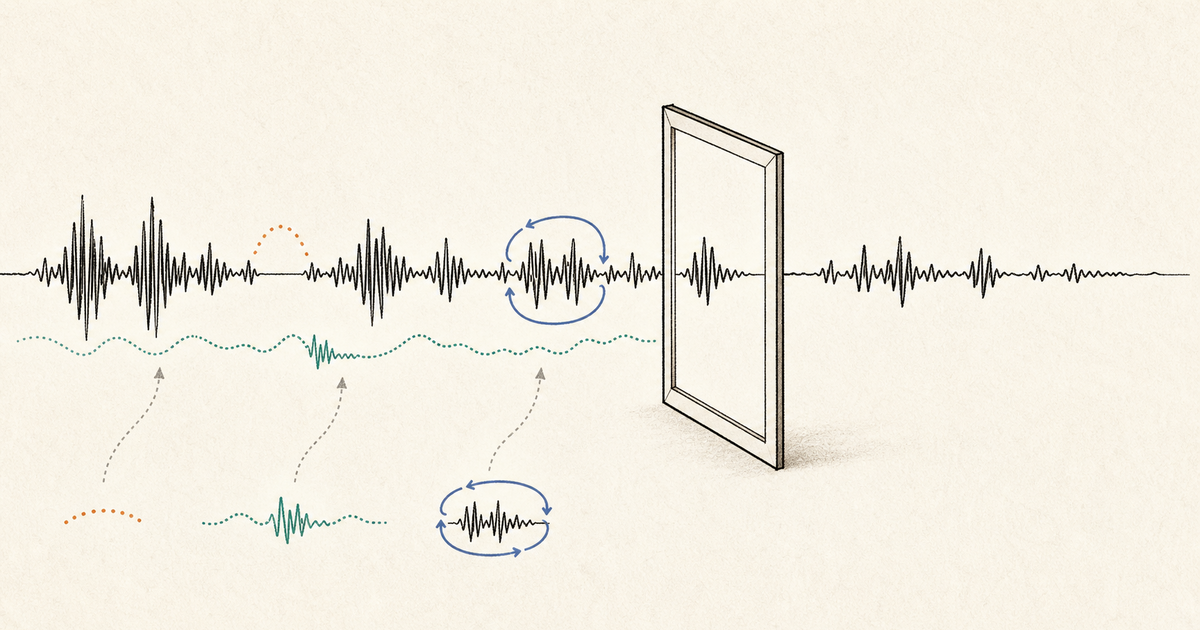
An AI Can Quote You Correctly and Still Get You Wrong
An exact journal quote can support the wrong conclusion when context, timing, or later corrections disappear. Check more than whether the words match.

An AI journal can reproduce your words exactly and still misread you. The problem is easiest to see when an old statement becomes a current intention, or a sentence loses the qualification that followed it. Checking whether a quote exists is only the first part of checking the insight.
For anything that might affect a decision or your view of a relationship, read the surrounding entry. Ask whether the quoted passage supports the conclusion the AI attached to it.
The quote is real; the conclusion doesn’t follow
Consider this fictional journal entry:
On Monday I told Jo, “I want to leave.” Today I want to try a different schedule before deciding whether to resign.
An AI might summarize this as: “You want to leave your job,” supported by the exact quote “I want to leave.”
No words were invented. The error is temporal: the conclusion treats Monday’s statement as your current position and drops today’s change of mind. A more faithful account would preserve both positions and their order.
You could catch a similar error in a typed entry, a voice transcript, or a chat summary. It concerns the relationship between the source and the claim, not the input format.
- The phrase appears in the entry
- The speaker is identified correctly
- The quote has not been altered
- The timing matches the claim
- Conditions and corrections remain intact
- The surrounding passage supports the interpretation
Citation quality includes support, not just a link
The ALCE research benchmark evaluates AI answers along separate dimensions including fluency, correctness, and citation quality. Its citation tests distinguish whether a cited passage supports a claim from whether an answer’s claims are sufficiently supported overall.
Those distinctions are useful for journal review, even though ALCE tested information-seeking answers rather than personal journals. A polished paragraph with a link can still overstate what the linked entry says. The paper’s historical model results are not an error rate for Lound or any current journaling product.
Source access makes an interpretation easier to inspect. It doesn’t remove the need to inspect it.
Check the words that control the meaning
Before accepting an important interpretation, look for four kinds of context:
- Time: “I used to dread Sundays” describes a different period from “I dread Sundays.”
- Speaker: “My manager said I sounded angry” reports someone else’s judgment, not necessarily your own assessment.
- Condition: “I would leave if the hours changed” doesn’t establish an unconditional plan to leave.
- Correction: “I felt rejected. Actually, I think I was embarrassed” contains a revision worth preserving.
These distinctions matter when an AI summary omits part of the entry. A shorter account must omit something, but it shouldn’t silently turn a possibility into a decision or an earlier thought into your final position.
Split a large claim into smaller checks
The FActScore paper evaluates long generated text by breaking it into smaller factual statements and checking their support. Its original experiments concerned generated biographies, not journals. The useful adaptation is to avoid accepting a whole paragraph because one part has evidence.
Suppose an insight says: “You feel drained after team meetings because you avoid disagreeing.”
There are at least three things to check: whether you described feeling drained, whether the entries connect that feeling to team meetings, and whether avoiding disagreement explains it. An entry could support the first two while saying nothing about the third.
If the explanation is plausible, keep it as a question: “Could holding back contribute to this?” Then consider alternatives such as meeting length, workload, or poor sleep. Our guide to checking an AI-detected journal pattern covers the separate question of whether several entries justify a recurring pattern.
Ask for the passage that complicates the answer
In Lound, you can open the entries linked to an insight and review the source. You can also use this request when discussing your journal with an AI:
Show the surrounding passage for this claim. Separate what I explicitly said from your interpretation, and look for a later correction or an entry that contradicts it.
Treat the resulting response as another answer to check, not a guarantee that the model found everything. Looking for counterexamples in your journal helps prevent a memorable quote from representing the entire record.
You don’t need to verify every harmless paraphrase. Spend the effort where an interpretation could change what you do. A useful correction can be precise: “That quote is from Monday. My next entry changed the plan.”
Questions people ask
Can an accurate quote still make an AI journal insight misleading?
Yes. The words may be copied accurately while the interpretation ignores who said them, when they applied, a condition, or a later correction.
How do I check an AI journal quote?
Open the entry, read the surrounding sentences, and compare the exact claim with what the passage supports. Check dates, speakers, conditions, and corrections before accepting the interpretation.
Does a citation prove an AI answer is correct?
No. A citation makes a source inspectable. You still need to check that the source supports the specific claim and that important parts of the answer have support.