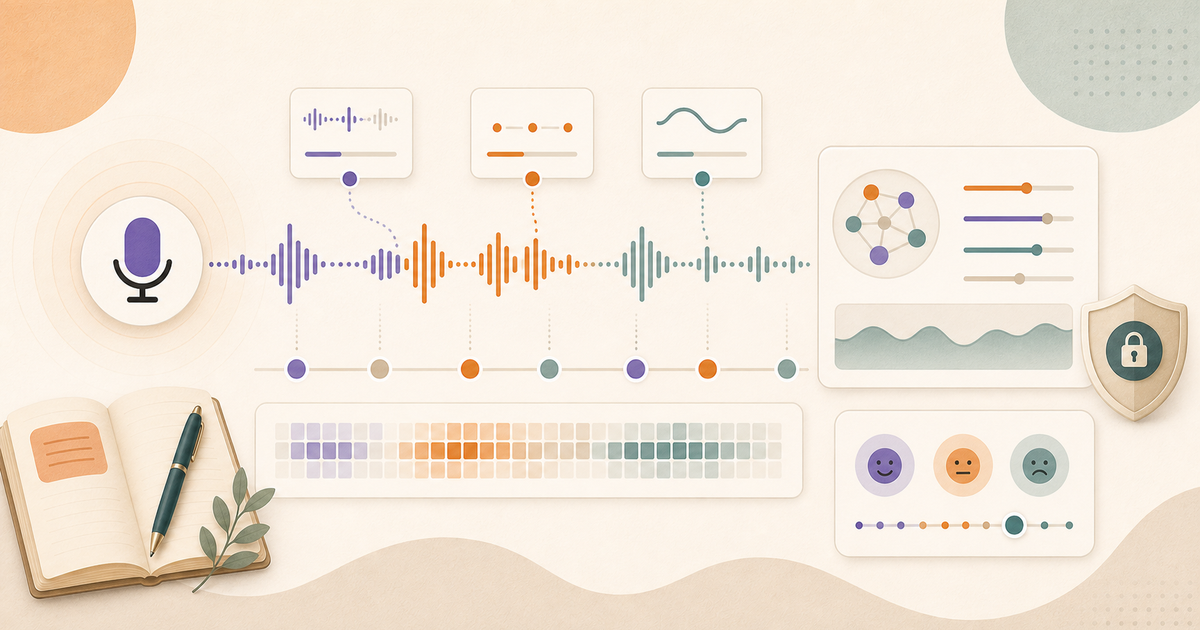
Can AI Tell How You Feel From Your Voice?
Voice AI can detect acoustic patterns, but emotion labels are uncertain and context-dependent. Here is what the signal can honestly tell you.
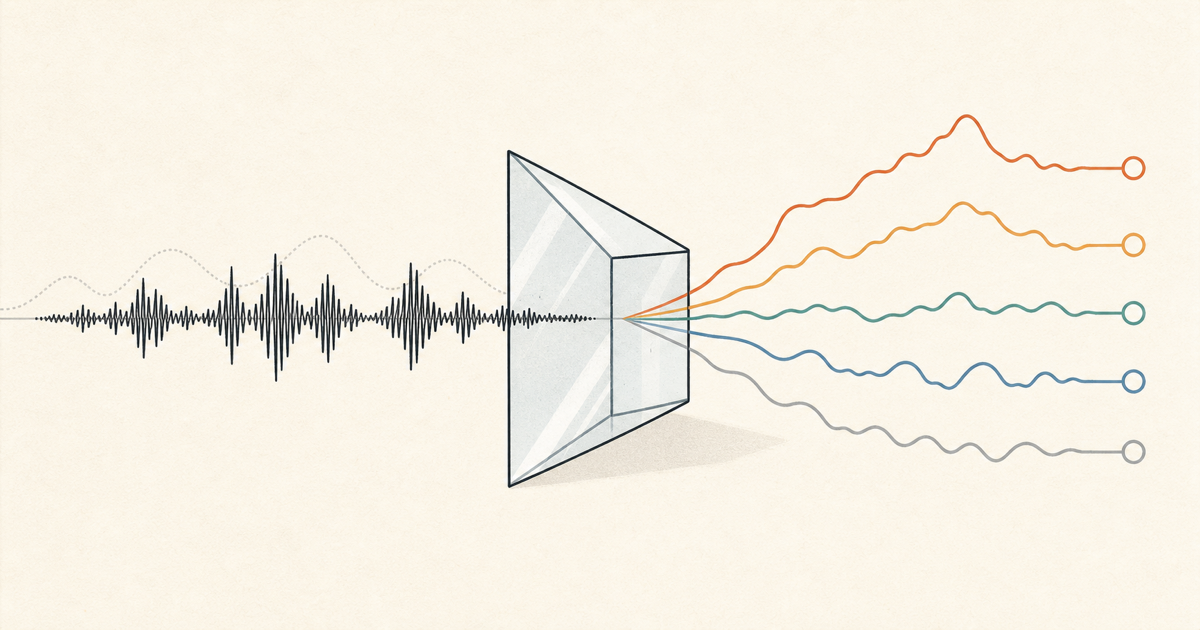
AI can find patterns in your voice that often travel with emotion. It cannot open the audio and discover a hidden, objective label called “what you really feel.”
That distinction matters. Speech-emotion systems can measure pace, pitch, intensity, pauses, vocal quality, and language. But even human listeners disagree about ambiguous emotion, and a 2025 Apple speech-emotion study found that collapsing several raters into one “ground truth” label can hide that uncertainty.
The honest output is a clue with confidence and context, not a verdict.
What the model can actually measure
A recording contains acoustic features that a transcript removes:
- how quickly you speak
- where you pause
- how much your pitch varies
- how loud or quiet the signal is
- changes in vocal energy
- breathiness, strain, or roughness
- timing between words and phrases
Models learn statistical relationships between combinations of those features and labels supplied by human raters. If many training examples labeled “angry” contain louder speech and wider pitch variation, the model may learn to recognize that pattern.
This is useful pattern classification. It still does not establish why your voice changed. A faster pace can reflect excitement, anxiety, caffeine, a noisy room, a tight schedule, or the fact that you are telling a story you know well.
The ground truth is unusually slippery
For object recognition, the label “bicycle” can usually be checked against the image. Emotion is different.
Possible labels include:
- what the speaker says they felt
- what a listener thought the speaker felt
- what the speaker intended to express
- what facial, vocal, or physiological signals suggested
- which category best fit a fixed menu
Those answers can disagree without anyone lying.
The Apple researchers treated rater disagreement as information rather than noise. Their work also warns that strong overall test results can hide differences across speakers, genders, and unseen recording conditions. A separate cross-cultural study of vocal emotion found an in-group advantage, meaning people and models do not interpret emotional speech independently of culture.
Why benchmark accuracy can mislead
Many speech-emotion datasets use actors reading short lines with an assigned emotion. Those clips are clean, intense, and easy to label. A real journal entry is messy.
You may sound flat because you are exhausted while describing something joyful. You may laugh while recounting a frightening event. Your microphone may compress volume. Your accent, medication, illness, age, or speaking style may look unusual relative to the training data.
That is why recent research has moved toward spontaneous speech and speaker-independent testing. The Interspeech 2025 naturalistic emotion-recognition challenge focused on real-world conditions and combined audio with text. The research direction itself tells us something: clean laboratory emotion clips were not enough.
Baselines are more useful than universal labels
The safest question is rarely “Does this clip sound sad?” A better question is “How does this entry differ from this person’s usual entries?”
Your baseline might show:
- you pause more before discussing one relationship
- work entries become faster and shorter near deadlines
- your energy drops for several days before you call it burnout
- you say “fine” with very different surrounding language
- relief appears as slower speech after a decision
Longitudinal comparison does not remove uncertainty. It gives the uncertainty a relevant reference point.
This is the useful version of voice pattern recognition: surface a change, show the evidence, and let the person interpret it. “Your pace has been lower than your recent baseline” is inspectable. “You are depressed” is a clinical claim a journal app should not make.
A responsible emotion insight has four parts
Any AI-generated observation about voice should answer:
- What changed? Name the feature, such as pace or pause length.
- Compared with what? Use the same speaker’s history when possible.
- How certain is it? Show ambiguity instead of forcing one label.
- What else could explain it? Include context and recording conditions.
Then the system should ask a question:
“You spoke more slowly than usual in three entries about work. Did that feel like calm, fatigue, caution, or something else?”
That question keeps authority with the speaker.
What a transcript still gets right
Audio is not automatically more truthful than text. The words contain evidence that acoustic features cannot supply:
- the event being discussed
- the meaning you assigned to it
- who was involved
- whether a change felt welcome
- what you wanted to do next
A transcript also makes entries searchable. You can compare every time you mentioned a manager, a symptom, or a recurring decision. An emotional calendar becomes more useful when it connects what changed with what was happening.
If audio retention matters to you, check the app’s actual controls and privacy policy. Some people want playback; others prefer to keep only the transcript. The right choice depends on whether the benefit of preserving vocal context is worth the additional sensitive data.
The same questions apply to every AI journal privacy policy: what is stored, for how long, for which purpose, and under whose control.
The answer to trust
AI can hear patterns associated with emotion. It cannot confirm the private experience behind them.
Use a voice label as a prompt to inspect, not a fact to obey. A useful journal helps you ask, “What changed here, and does that match my experience?” It does not claim to know you better than you know yourself.
Questions people ask
Can AI detect emotion from a person's voice?
AI can classify acoustic patterns associated with emotion, such as pace, pitch, energy, and pauses. It cannot directly know a person's private emotional state.
How accurate is speech emotion recognition?
Accuracy varies by dataset, speaker, language, recording conditions, and the emotion categories used. Performance on staged benchmark clips does not guarantee reliable results in ordinary life.
Can voice analysis diagnose anxiety or depression?
A consumer voice analysis should not be treated as a diagnosis. Clinical screening requires validated methods, appropriate populations, consent, and professional interpretation.
What is the safest use of emotion AI in a journal?
Use it to notice changes from your own baseline and to generate questions for reflection, while keeping your words, context, and judgment in control.