How AI Spots Emotional Patterns in Voice
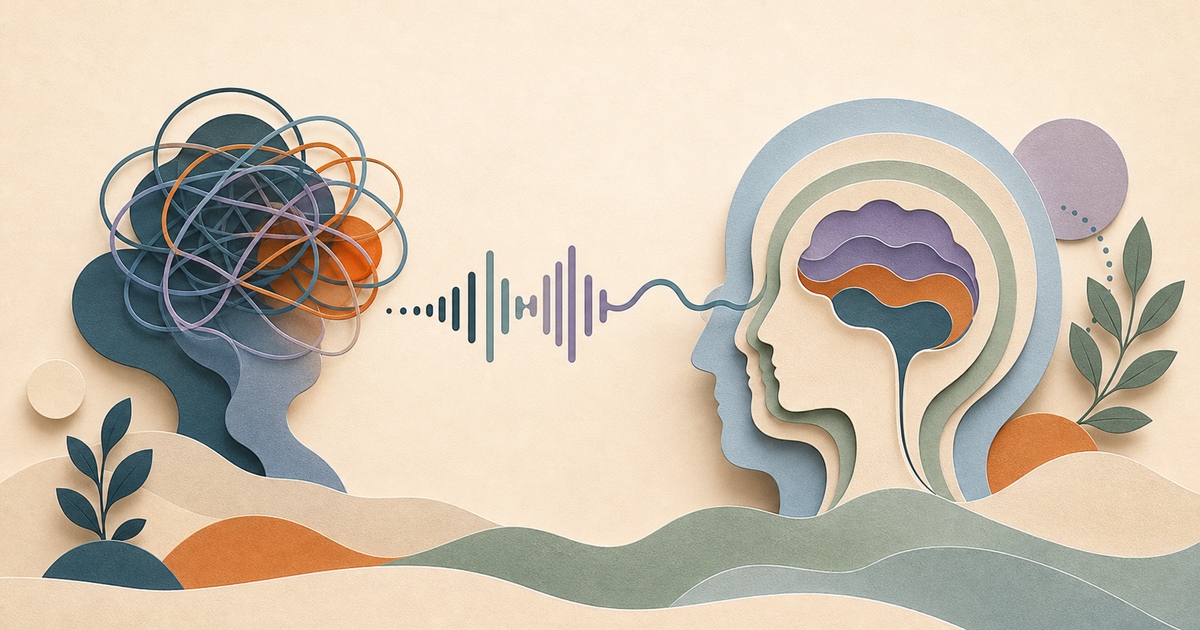
Voice can carry clues through pace, pitch, pauses, and wording. AI can summarize patterns over time, but it should not diagnose you.
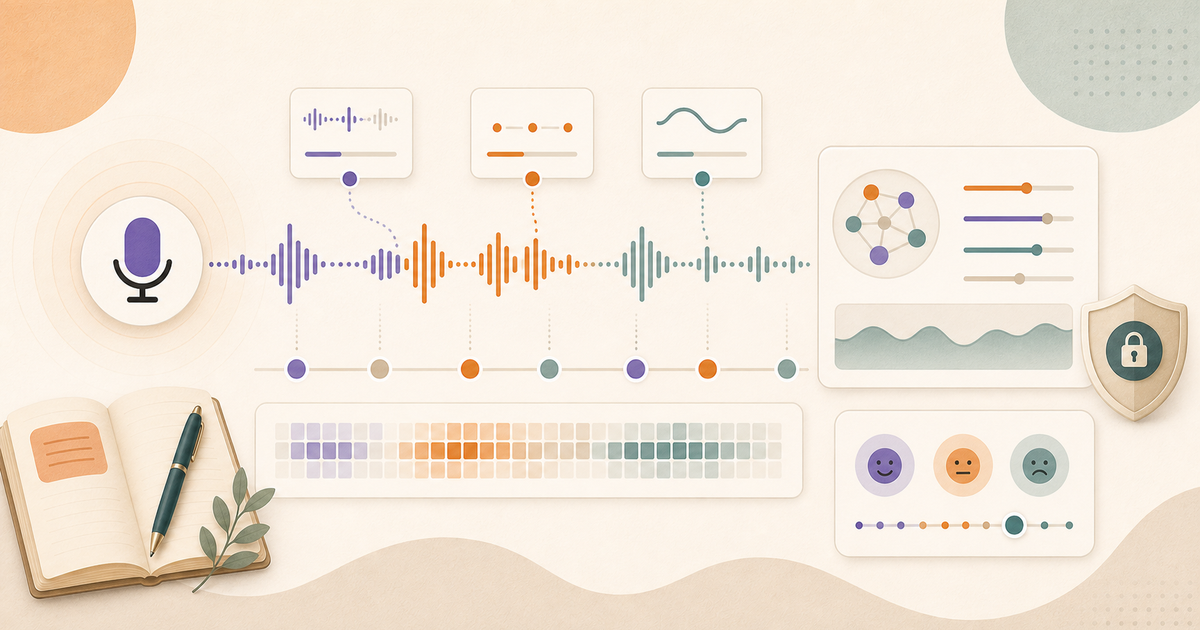
When you speak, you give more information than words alone. Your voice carries context through tone, pace, pitch variation, vocal quality, and where you pause.
AI voice analysis can summarize these paralinguistic features, meaning the how of speaking, not just the words. Over time, that can help surface patterns you may not notice entry by entry.
That does not make AI a therapist or diagnostic tool. The useful role is narrower: turn your own words and voice patterns into evidence you can reflect on.
What Voice Analysis Can Detect
Prosody: The Melody of Speech
Prosody refers to the rhythm, stress, and intonation patterns in speech. It’s how you say something, independent of what you’re saying.
The same sentence, “I’m fine,” can mean:
- Genuine contentment (rising, relaxed intonation)
- Barely contained frustration (clipped, tense delivery)
- Deep sadness (flat, low energy)
- Sarcasm (exaggerated inflection)
Humans pick up on prosody intuitively in real-time conversation. AI can analyze prosody patterns across hundreds of recordings to identify emotional trends.
Research shows prosody carries emotional information that words alone miss. When verbal content and prosody conflict (saying “I’m happy” in a sad tone), people believe the prosody over the words.
Pitch and Vocal Quality
Voice pitch tends to:
- Rise during anxiety, excitement, or stress: higher baseline frequency
- Drop during sadness or exhaustion: lower baseline frequency
- Become more variable during anger: wider pitch range
- Flatten during low mood: reduced variability
Vocal quality changes include:
- Tension: constricted, strained sound
- Breathiness: indicating vulnerability or uncertainty
- Hoarseness: sometimes accompanying emotional distress
- Vocal fry: low, creaky tone sometimes linked to exhaustion
AI can track these features across time, noticing when your baseline vocal quality shifts in ways you wouldn’t consciously register.
Speech Rate and Rhythm
How fast you speak can give clues about emotional state:
- Rapid speech: can reflect anxiety, excitement, or racing thoughts
- Slow speech: can reflect low energy, exhaustion, or careful emotional regulation
- Variable rate: Might show emotional volatility or difficulty maintaining regulation
- Consistent pace: Typically indicates emotional stability
People with ADHD or racing thoughts often speak noticeably faster when overwhelmed. AI can detect this acceleration and flag patterns.
Pauses and Hesitation
Where and how long you pause carries meaning:
- Frequent hesitations: Uncertainty, anxiety, or careful word choice
- Filled pauses (“um,” “uh”): Cognitive load, searching for words
- Long silences: Emotional overwhelm, difficulty accessing language
- Strategic pausing: Deliberate, controlled communication
AI measures pause duration and frequency, identifying when your natural rhythm shifts.
How Pattern Recognition Works Across Time
Baseline Establishment
First, AI establishes your normal voice patterns:
- Your typical speech rate
- Your baseline pitch range
- Your standard vocal quality
- Your usual pause patterns
This baseline is highly individual. Some people naturally speak quickly. Others pause frequently. The baseline is you on a typical day, not an absolute standard.
Deviation Detection
Then AI monitors for deviations from your baseline:
“Speech rate 30% faster than baseline, possible anxiety or excitement”
“Pitch notably lower than usual, possible sadness or exhaustion”
“Increased hesitation and filled pauses, possible cognitive load or uncertainty”
These deviations become meaningful when patterns emerge.
Pattern Recognition Across Recordings
The real insight comes from analyzing dozens or hundreds of voice recordings:
- Temporal patterns: “You consistently sound stressed on Sunday evenings”
- Contextual patterns: “Your speech rate increases when discussing work projects”
- Emotional trajectories: “Vocal quality has been declining over the past three weeks”
- Topic correlations: “Certain keywords consistently coincide with pitch changes”
These patterns are invisible when reviewing individual entries, but AI can surface them automatically.
What This Reveals That You Don’t Consciously Know
Emotional Early Warning System
You might not consciously notice stress building until you’re already overwhelmed. But AI can detect subtle voice changes that precede conscious awareness:
- Slight speech rate acceleration
- Minor pitch elevation
- Increased pause frequency
- Vocal tension beginning
This earlier signal can help you respond before full overwhelm hits. You can address rising stress when it still feels manageable.
Unconscious Patterns and Triggers
Maybe you don’t realize that:
- You always feel worse after particular types of meetings
- Certain topics consistently trigger anxiety responses
- Your energy crashes at predictable times
- Specific people or situations affect your emotional state
AI surfaces these correlations. You get objective data about patterns your subjective experience misses.
Gap Between Stated and Actual Emotions
Sometimes what you say and how you say it don’t match:
You say: “I’m excited about this project” Your voice reveals: Flat affect, slow pace, low energy
This gap can indicate misalignment, possibly forced positivity, emotional suppression, or lack of self-awareness about actual feelings.
Voice captures emotional authenticity that self-reporting often misses.
Privacy and Ethics: How This Should Work
Voice emotion analysis raises legitimate privacy and ethical concerns. Here’s how responsible implementation should work:
Data Ownership and Control
- You own your voice data completely
- You control what gets analyzed and what doesn’t
- You can delete recordings permanently at any time
- No voice data is sold or shared with third parties
If a service doesn’t offer these protections explicitly, don’t use it.
Transparency About What’s Analyzed
You should know exactly:
- What features are being measured (pitch, pace, pauses, etc.)
- How patterns are identified
- What insights are generated
- Whether human reviewers ever access recordings (they shouldn’t)
Black box AI that won’t explain its analysis is a red flag.
Local vs. Cloud Processing
Consider where analysis happens:
- Local processing: analysis on your device, nothing uploaded
- Cloud processing: recordings sent to servers for analysis
Local processing offers stronger privacy but typically provides less sophisticated analysis. Cloud processing enables more powerful AI but requires trusting the service with your data.
Look for services that encrypt all data in transit and at rest, regardless of processing location.
What AI Voice Analysis Cannot Do
Let’s be clear about limitations:
It Cannot Diagnose Mental Health Conditions
AI can detect patterns suggesting emotional changes, but it cannot diagnose depression, anxiety disorders, or other clinical conditions. That requires professional evaluation.
Voice analysis might reveal concerning patterns that warrant professional consultation, but the AI itself is not a diagnostic tool.
It Cannot Read Your Mind or Predict Behavior
AI analyzes voice patterns rather than thoughts, and it cannot know what you’re thinking unless you speak it. Pattern recognition also does not equal prediction because humans are far too complex for that.
It Requires Sufficient Data
Pattern recognition needs multiple recordings over time. A single voice session is just one data point.
The insight comes from dozens of recordings analyzed together.
The Practical Value: Self-Awareness at Scale
The reason voice emotion recognition matters is what it can enable: self-awareness at a scale that is hard to get through manual review.
Traditional journaling requires you to read back through entries and notice patterns yourself. Most people never do this. The volume is too large, memory is too selective, and patterns are too subtle.
AI surfaces insights automatically:
- “You mentioned feeling overwhelmed 7 times this week, up from 2 last week”
- “Your speech rate has been consistently elevated for 10 days”
- “Vocal quality suggests declining energy over the past month”
This pattern recognition shows you what you can’t see yourself, which is exactly what makes it valuable.
The Bottom Line
Your voice reveals emotional patterns through prosody, pitch, rate, and vocal quality that words alone miss. AI analyzes these paralinguistic features across time, detecting trends invisible to conscious awareness.
The goal is not surveillance or mind-reading. The useful version gives you structured data about your subjective emotional experience so you can notice patterns earlier.
That boundary deserves precision: an emotion model can classify vocal patterns without knowing how you feel. Speaker, language, culture, context, and recording conditions can all change what the same acoustic feature means.
The technology only matters if it serves your self-awareness and wellbeing. It should be transparent about what it analyzes, protective of your privacy, and always under your control.
Voice journaling with AI pattern recognition extends human insight instead of replacing it. You still interpret the patterns. You still decide what they mean. You still choose what to do about them.
But now you can see patterns you’d otherwise miss entirely. And that visibility often makes all the difference.
Questions people ask
Can AI diagnose anxiety from your voice?
No. Voice analysis can summarize patterns in pace, pitch, pauses, and wording, but it should not diagnose anxiety or replace a clinician.
What voice features can AI analyze?
AI can analyze features such as speech rate, pitch variation, pauses, vocal energy, and repeated words or topics. These features are signals for reflection, not medical conclusions.
Why use voice for emotional pattern tracking?
Voice can preserve tone, hesitation, pace, and emphasis. Those details can help you notice recurring patterns that are easy to miss in written notes.