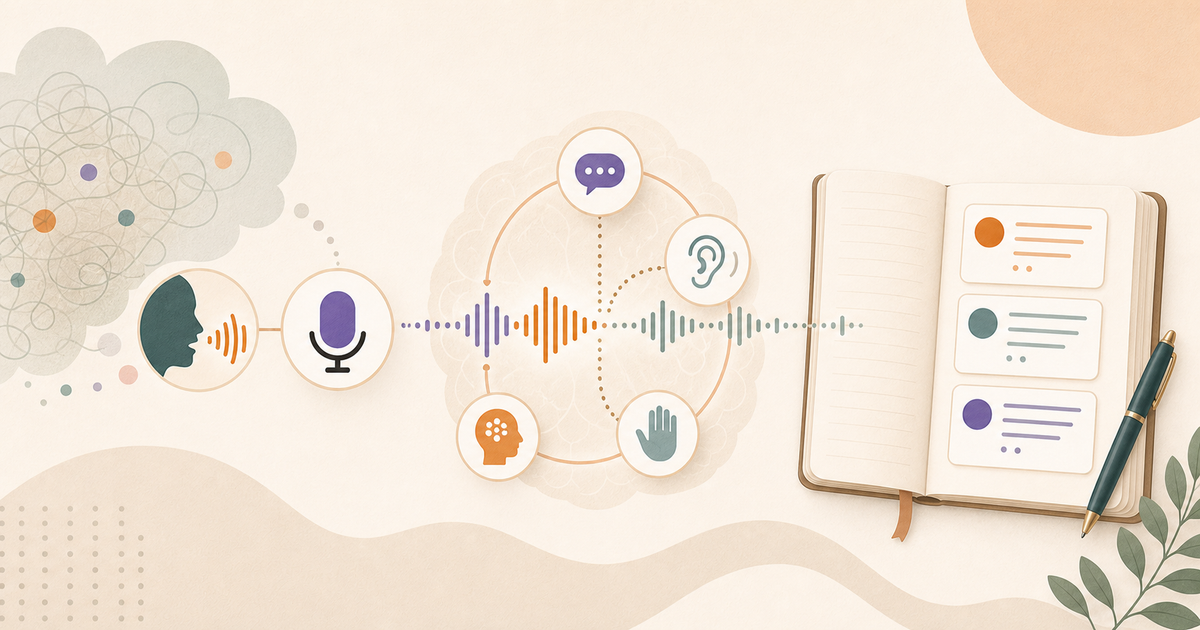
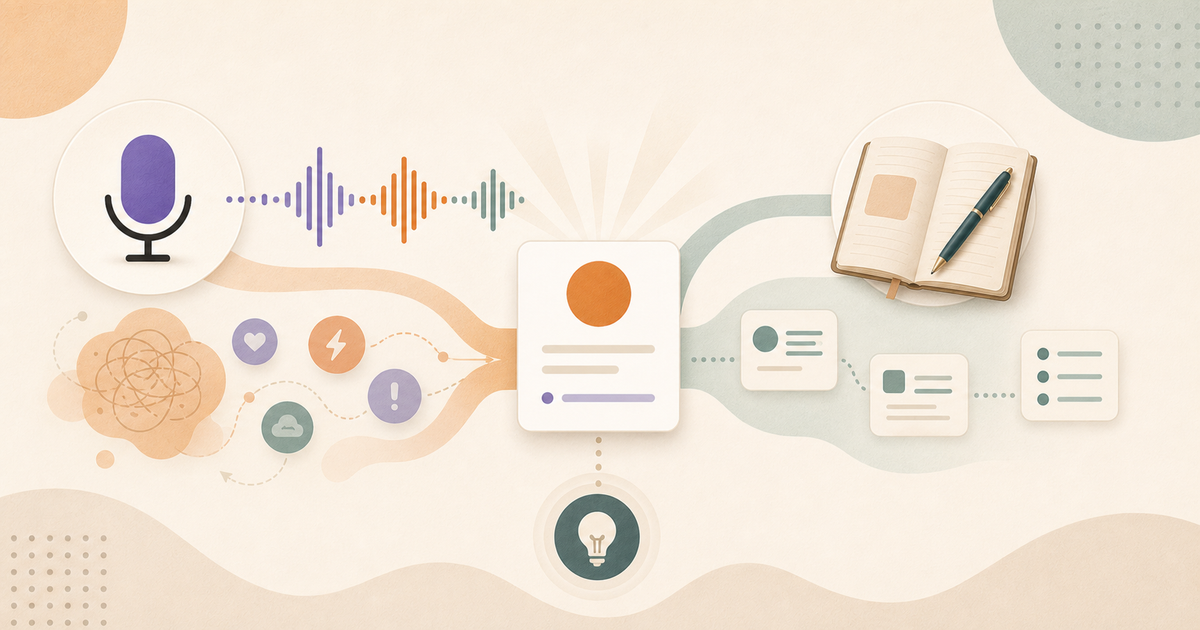
Inner Voice vs Outer Voice: Which Helps You Think?
Why can a thought feel clear until you say it? Explore inner speech, spoken self-talk, and a simple way to tell which helps with the task.
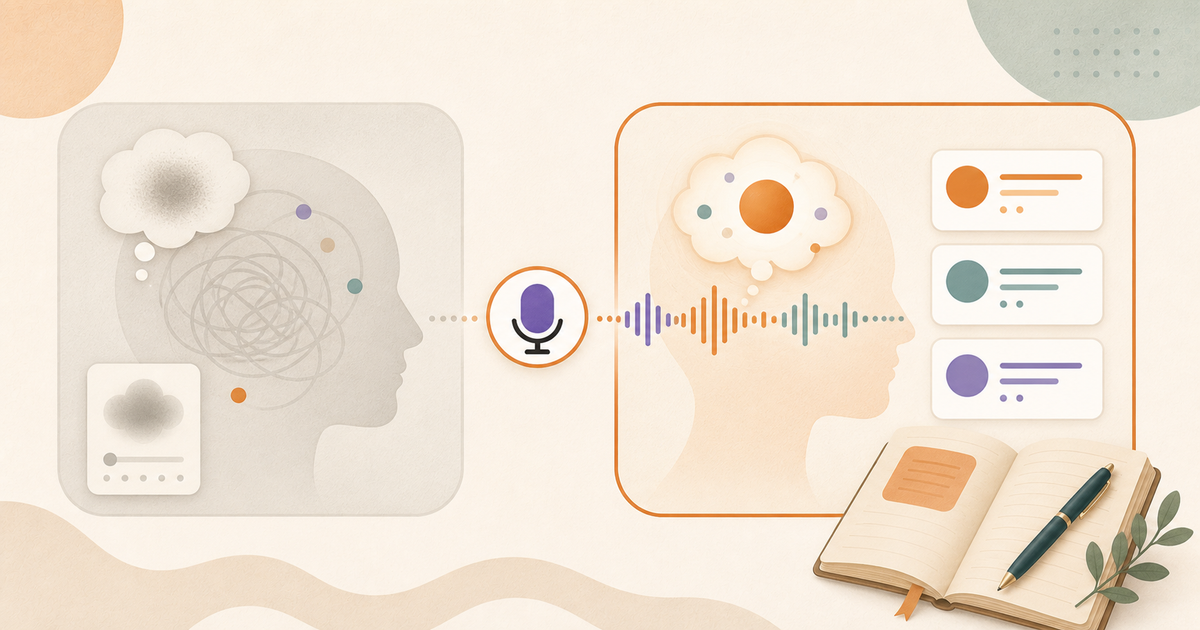
You can feel certain you understand something, then lose that certainty halfway through explaining it. Inner speech and spoken speech give you different ways to work with a thought; neither is the best tool for every situation. Saying the idea aloud gives you actual wording to inspect, which can expose a missing detail.
“I know what I need to ask” becomes “I need to ask whether Friday means a draft or a finished version.” That extra precision can matter more than how confident the thought felt in your head.
What is inner speech?
Inner speech is verbal thinking without audible speech. It can resemble a sentence, a brief phrase, an imagined exchange, or a compressed reminder that makes sense only to you.
Alderson-Day and Fernyhough’s review describes this variety and the challenges of studying it. Asking people about their usual experience, sampling a moment of thought, and giving them a laboratory task don’t necessarily capture the same thing.
That matters when you hear sweeping claims about how many people are “internal” or “external” processors. A preference for talking things through doesn’t establish a fixed brain type. You can rehearse a question silently, solve another problem with a diagram, and explain a third one aloud.
Silence also doesn’t imply an absence of thought. A running verbal commentary is only one form thinking can take.
What changes when you say the thought?
Try the difference between “the plan won’t work” and explaining which part won’t work. You might discover that you mean the budget is unclear, or that two people are assigned incompatible deadlines.
Speaking gives the sentence an order and lets you hear what you actually said. Writing can do something similar while allowing you to rearrange the words. The advantage depends on where you get stuck.
An audible sentence also disappears unless you remember or save it. Calling speech “external memory” skips an important step: a recording, transcript, or written note is what gives you something persistent to return to.
- Work through an idea in the moment
- Try wording without keeping a record
- Notice where the explanation becomes unclear
- Preserve a version for later comparison
- Find the exact concern you described
- Check how your interpretation changed
Can talking ever make a task harder?
Yes. An interesting visual-search experiment by Lupyan and Swingley asked participants to find common objects while sometimes saying the target’s name. Naming helped particularly when the word strongly matched the visual target. As the match weakened, speaking could impair performance.
That result is narrower than “self-talk makes you smarter.” It suggests that what you say, and how well it fits the task, matters. It wasn’t a journaling or ADHD treatment study.
You may also find that narrating a visually demanding task interrupts your concentration. There is no reason to continue just to be consistent with a label like “verbal processor.”
Try an explanation that can reveal a gap
Choose an ordinary decision, such as whether to accept an extra project. First note your initial view: “I think I should say yes.”
Then explain it aloud using three questions:
- What am I choosing between?
- What fact would change my answer?
- What am I assuming without checking?
An example: “I’m choosing between the new project and keeping time for the existing one. If the deadline is flexible, I can do both. I’ve assumed it isn’t flexible, but nobody said that.”
The useful result is the unanswered question. You don’t have to talk yourself into feeling certain. Our self-talk examples offer more wording for specific situations.
This exercise is a practical suggestion, not a research protocol. If speaking produces a longer version of the same loop, switch to a short written list or stop.
When to keep the thought private or silent
Talking aloud isn’t always convenient. You may share an office, be around other people, or simply prefer quiet. You can write the key question, think it through silently, or wait for a private setting.
For emotions, spoken language has no exclusive claim on the evidence. The 2007 UCLA affect-labeling study used button responses, not spoken journal entries. Naming a feeling needn’t become a performance into a microphone.
When a journal adds something
Save an explanation when you expect to need it again. For example, record why you accepted the project, what you assumed about the deadline, and which question remains open. Later you can compare the record with what happened.
Lound can transcribe a spoken entry and generate a summary. Read that summary as an interpretation and correct important recognition errors. Audio can be retained on your device if you want playback; a transcript alone doesn’t preserve the full delivery.
You can also use a notebook or an ordinary recorder. The voice-versus-writing comparison covers the tradeoffs. For your next decision, try explaining just the part you haven’t checked yet and see whether it gives you a better question.
Questions people ask
What is the difference between inner and outer speech?
Inner speech is verbal thinking without speaking aloud. Outer speech is audible language. Speaking to yourself is often called private speech or self-directed speech.
Does everyone have a constant inner monologue?
No. Inner speech varies between people and situations, and thought need not always take the form of a running verbal commentary.
Is thinking out loud better than thinking silently?
It depends on the task and the person. Saying a thought can help you inspect its wording, but speech can also distract. Research on specific tasks does not establish that speaking is universally better.
Do I have to record myself to think out loud?
No. Speaking can help you work through a thought without saving it. Recording or transcribing adds a record you can revisit later.