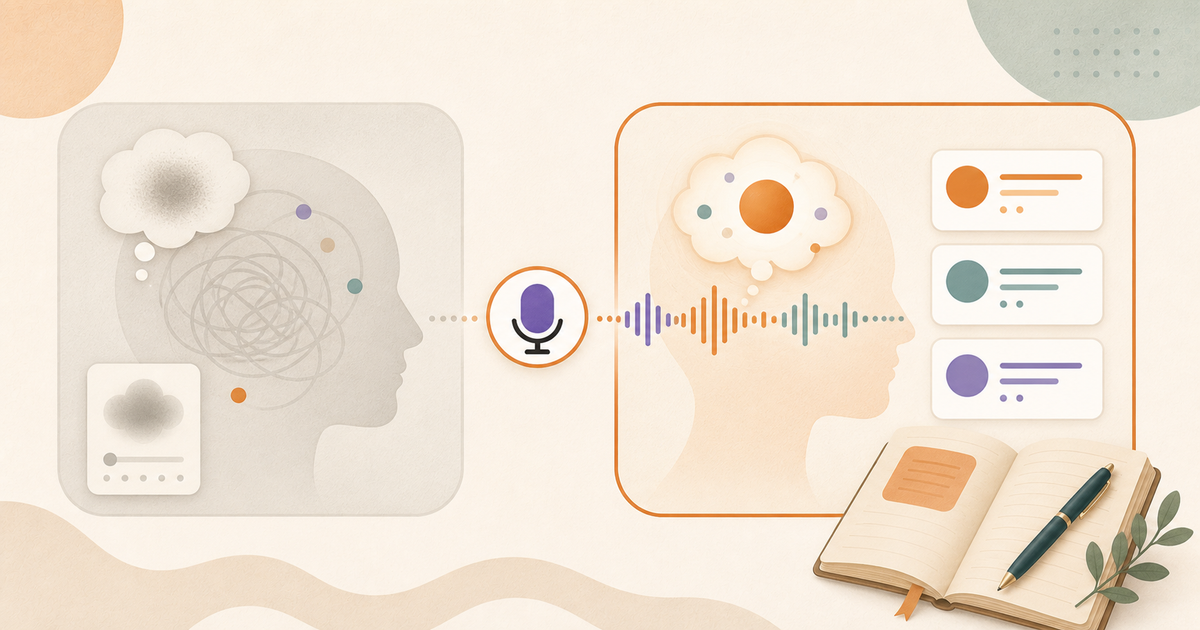
ADHD Brains Think Better Out Loud (Here's Why)
People with ADHD think better out loud because speech does the holding that working memory struggles with. The mechanism, the research, and how to use it.
People with ADHD think better out loud because speaking takes over the job that working memory keeps dropping. When you say a thought, the words hold their own place for a moment, your ears catch them, and your brain gets to spend its limited capacity on the next step instead of on gripping the last one. Two lines of research explain why this matters more with ADHD than without it. Working memory deficits are among the most consistently measured features of ADHD in both children and adults. And Russell Barkley’s influential model of ADHD treats the internalization of speech, the developmental shift from talking to yourself out loud to thinking silently, as one of the executive functions that runs late. Put those together and out-loud thinking stops looking like a quirk. It is a tool that never fully went underground, and it still works.
This post explains the mechanism. If you want the identity side of this (“I’m not oversharing, I’m processing”), read You’re Not Broken, You’re Voice-Activated. Here we stay on the why.
What does working memory have to do with it?
Working memory is the mental workspace where you hold a few pieces of information while you use them: the sentence you are building, the step you are on, the reason you walked into the kitchen. Everyone’s workspace is small. The general 4-item picture is covered elsewhere on this blog, so here is the ADHD-specific part.
The deficit is real and it is not small. A meta-analysis of 26 studies of children with ADHD found working memory impairments across verbal and spatial tasks, with the largest gaps in spatial tasks that required manipulating information, not just storing it. The effects held after accounting for language disorders and general ability. For adults, a meta-analytic review of 38 studies found moderate-size deficits in both phonological and visuospatial working memory compared with controls, and concluded that the deficits persist into adulthood.
In practice, a working memory that leaks looks like this. You start a thought, a second thought arrives, and by the time you have dealt with the second one the first is gone. You read a paragraph and reach the end without the beginning. You know there was a reason you opened this tab. None of that is a knowledge problem. The information was there and then it was not.
Speaking changes the load. When you say “okay, the question is whether to move the meeting or cancel it,” you have created a version of that thought that lives outside your head for a second or two, long enough to act on it. If you record it, it lives indefinitely. Either way, the slot in working memory that was holding “what was the question again” is free.
Why does Barkley’s theory of ADHD point straight at speech?
In 1997, Barkley proposed a unifying theory of ADHD that still shapes how clinicians think about it. His core claim is that ADHD involves a deficit in behavioral inhibition, and that this deficit disrupts four executive functions that depend on it: working memory, self-regulation of emotion and motivation, the internalization of speech, and what he called reconstitution, the ability to take ideas apart and recombine them.
The third one is the interesting one here. “Internalization of speech” refers to the developmental process, first described by Vygotsky, in which children’s out-loud self-talk gradually goes quiet and becomes verbal thought. Barkley argued that in ADHD this process is delayed. Self-directed speech stays external longer, and even once it goes internal it is less able to do its job of guiding behavior, because inhibition is what gives speech time to act before impulse does.
Read that from the other direction and it explains a lot. If your inner voice is a weaker guide than most people’s, the audible version is a reasonable substitute. It is louder, slower, and harder to ignore. Adults with ADHD who mutter their way through a form, narrate a task, or say “no, don’t open email yet” out loud are supplying externally what the internal system delivers unreliably.
What does private speech research show?
Vygotsky observed in the 1930s that young children talk to themselves while they work, and he argued that this “private speech” is how thinking develops: language starts as communication with others, becomes self-direction out loud, and finally goes silent as inner speech. Laura Berk carried this into modern developmental psychology and summarized decades of evidence in a Scientific American piece that is still worth reading. Children talk to themselves most when tasks are hard, and the ones who use task-relevant self-talk tend to do better, not worse.
The ADHD-specific studies are where it gets useful. In a classroom observation study, Berk and Potts compared 6- to 12-year-old boys with ADHD to matched peers during math seatwork. The boys with ADHD used more externalized, self-guiding speech and less of the muttered, partly internalized speech that older children usually show. Their private speech was developmentally delayed, exactly as Barkley’s model predicts. Two more findings matter for adults. Self-guiding speech was linked to better attention only among the least distractible boys with ADHD, and when the boys were on stimulant medication their private speech became more mature and more tied to staying on task. The authors concluded that the relationship runs both ways: speech helps regulate attention, and a manageable attentional system is what lets speech do that job.
Adam Winsler’s review of private speech research frames private speech as a core piece of how executive function develops. His own study of boys with ADHD found that their private speech was less connected to what they were doing in the moment than typically developing children’s, which fits the same story: the tool is present, and it needs conditions that let it grab hold.
Nobody has run these classroom studies on 35-year-olds. But the developmental logic is clear enough to act on. Self-directed speech is a self-regulation tool. In ADHD it stays audible longer and gets less traction on its own. So the practical move is to give it traction on purpose.
Why does saying it out loud work better than just thinking it?
Three things happen when a thought becomes sound that do not happen when it stays silent.
You get an external copy. The word is in the air, and if you are recording, on a device. Working memory does not have to hold it.
You get a feedback loop. You hear yourself. Adults with ADHD often describe realizing what they think only once they hear themselves say it, and part of that is simply that listening is a second pass through the same content by a different route.
You get sharper attention. Words tune perception more than most people expect. In a series of experiments, Lupyan and Swingley had people search for objects on a screen and found that saying the target’s name out loud sped up the search, compared with reading the name silently. Saying “keys” makes you a slightly better key detector. That is a small lab effect, but it is the same mechanism you use when you say “phone, wallet, badge” at the door and actually leave with all three.
Speed matters too. In a controlled comparison, speech input ran 2.93 times faster than typing on a phone (153 versus 52 words per minute in English). For thoughts that arrive in bursts and evaporate, that gap is the difference between capturing them and losing them. The full case for voice over writing when you have ADHD is its own post, so we will not repeat it here.
Is talking to yourself a sign of ADHD?
No. Talking to yourself is normal and common in adults, and it is not part of any diagnostic criteria. Plenty of people without ADHD narrate their cooking and rehearse conversations in the car.
The difference is one of degree and reliance. The child studies show more audible self-guiding speech in ADHD, and Barkley’s model explains why the silent version is a weaker substitute. So if you have ADHD and you think out loud a lot, that is consistent with how your executive system works, but the reverse inference (I talk to myself, therefore I have ADHD) does not hold. If you are wondering about a diagnosis, that is a conversation for a clinician, and nothing here is a treatment or a substitute for one. Out-loud thinking is a self-regulation habit you can use alongside whatever else you and your doctor decide on.
What should you actually do with this?
Knowing the mechanism tells you where to aim. Speech helps most when it is task-relevant and applied at the moment working memory is about to fail. Four patterns cover most of the day.
Say the first step to start. Task initiation is where a leaky working memory hurts most, because you have to hold the whole task and choose an entry point at the same time. Saying one concrete action out loud (“open the doc and write the subject line”) collapses that. The say-to-start method is a short read if starting is your main problem.
Narrate while you work. Once you are moving, a running commentary at points of friction (“done with the intro, next is the numbers”) leaves breadcrumbs you can pick up after an interruption. There is a right way to do this that keeps it from becoming a distraction, covered in narrating tasks out loud.
Record racing thoughts instead of holding them. When there are ten thoughts and one head, talking them into a recorder empties the queue without deciding anything. Voice journaling for ADHD racing thoughts walks through the routine.
Think out loud with someone, on purpose. A meeting or a call where you can say “let me talk through this” gives you the external loop with a listener attached. Telling people that this is how you process, before you do it, removes most of the awkwardness.
A tool that transcribes and keeps your voice notes turns the moment-to-moment offloading into a record you can search later, which is the part your memory would otherwise have to do. If you want a comparison of options built for this, the best journaling apps for ADHD roundup covers voice, tap, and typing tools side by side.
When does thinking out loud stop helping?
The Berk and Potts finding cuts both ways. Self-guiding speech helped the boys who could already hold attention reasonably well. When distraction was very high, the speech was there but it was not steering. For adults, the equivalent is talking in circles: repeating the problem without ever naming a next step. If you catch yourself on the third lap, change the sentence. “What is the one thing I do next?” is usually enough to turn narration back into direction.
The other limit is content. Speech that describes the task helps. Speech that describes how bad you are at the task does not, and it competes for the same slots. Keep the words pointed at the work.
The bottom line
The reason ADHD brains think better out loud is not mysterious. Working memory is measurably smaller and leakier in ADHD, and the inner voice that most adults use to steer themselves is, in Barkley’s account, slower to develop and weaker at the wheel. Audible self-talk fills both gaps: it holds the thread outside your head, and it directs behavior with a signal that is harder to lose. Children with ADHD keep using it longer for exactly that reason. Adults who never stopped are not behind. They found the workaround early. The job now is to use it deliberately: say the first step, narrate the friction, record what races, and keep the words on the task.
Questions people ask
Why do people with ADHD think better out loud?
ADHD comes with measurable working memory deficits, and speaking moves part of the holding job out of working memory and into the room. Barkley's model of ADHD also treats the internalization of speech as one of the executive functions that develops late, so self-directed speech stays useful out loud for longer.
Is talking to yourself a symptom of ADHD?
No. Talking to yourself is normal in adults and is not a diagnostic sign of anything. Research on children shows those with ADHD keep using audible self-guiding speech longer than peers, which is a difference in how a common tool is used, not a symptom on its own.
Does thinking out loud actually help with ADHD, or is it just a habit?
It helps most when the speech is task-relevant: naming the next step, restating the question, or narrating what you are doing. Berk and Potts found self-guiding speech was linked to better focus in the least distractible children with ADHD, so it works best when attention is already somewhat managed.
What is the best way to use out-loud thinking with ADHD?
Speak at the point of friction: say the first step to start, narrate while you work to keep the thread, and record racing thoughts instead of writing them. A voice note or voice journal keeps the words so you do not have to hold them.