Voice Journaling: The Complete Guide (2026)
Make a first voice-journal entry you can actually use later. What to say, how to find it again, and what audio, transcripts, and AI each preserve.
Voice journaling means recording a personal reflection so you can keep or revisit it. You can start with an ordinary recorder and one recent event. Transcription and AI can help organize the result, but neither is required to make the entry useful.
For your first attempt, choose something small enough to describe without retelling your entire week: a conversation, a decision, or a detail you don’t want to forget.
Make your first entry about one event
Find somewhere you can speak privately and safely. Don’t record while driving or during another activity that needs your attention. Avoid capturing other people’s conversations without their permission.
Start with three questions:
- What happened?
- What do I currently make of it?
- What, if anything, do I want to revisit?
Here’s a fictional example:
I said yes to hosting dinner next weekend, then felt irritated about it. I think I pictured doing all the cooking myself, though nobody asked me to. Before I cancel, I’ll ask whether everyone can bring something. I want to remember that I haven’t actually asked yet.
The last sentence matters. It keeps an assumption from becoming the settled story of the event. You don’t need to sound fluent, narrate every detail, or solve the problem before stopping.
A minute or two is a manageable starting experiment, not a scientifically required duration. Stop when you have captured what you wanted to keep.
Give the recording a useful second life
Saving the file is only part of the process. Make it possible to find the entry when it becomes relevant.
If you use transcription, check names, numbers, negatives, and important wording. A missing “not” can change the meaning of an entry. Don’t assume a polished summary proves that every detail was understood correctly.
For a plain audio file, use a descriptive filename. In a journal app, use a specific title or a searchable phrase. “Dinner: ask for help” gives you more to retrieve than “Thoughts.”
Understand what you’re saving
An audio recording, a transcript, and an AI reflection are different records.
| Record | What it provides | What to check |
|---|---|---|
| Audio | Your recorded words and delivery | Whether you want to retain it and who could access it |
| Transcript | Recognized words you can read or search | Misheard names, omissions, and punctuation |
| AI summary or themes | A shorter interpretation of the entry | Missing context, mistaken conclusions, or labels that don’t fit |
Hearing your delivery can prompt a useful observation, but tone alone doesn’t reliably tell you what you felt. Text can preserve emotional detail when you describe it explicitly: “I sounded cheerful because I didn’t want to explain.”
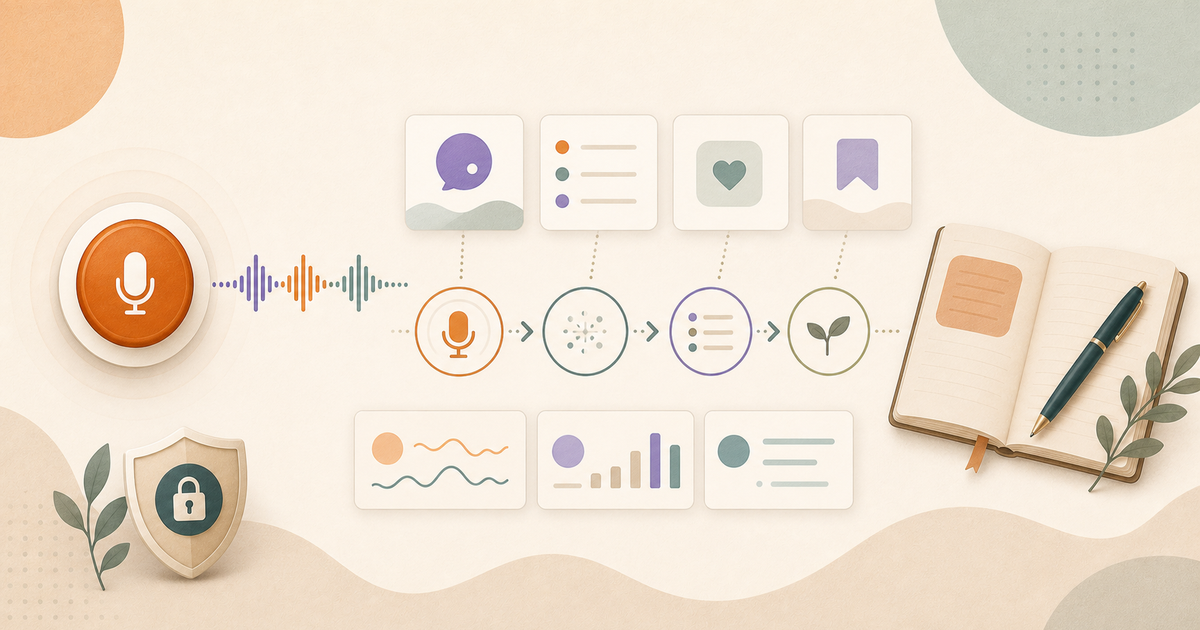
Lound generates a transcript, summary, mood, and themes from your entry. Treat the AI output as something to review, not a diagnosis or an authoritative explanation of you.
Choose voice or writing for the situation
Voice can suit a rough account you find easier to explain than compose. Writing can suit a shared room, a quiet train, or a decision whose options you want to see side by side.
- Say the rough version in a private setting
- Keep audio if you want to hear it later
- Use a transcript when you want to scan
- Capture something without speaking
- Arrange details or compare options
- Revise the wording as you think
The voice-journaling versus writing guide explains the tradeoffs and the limits of the popular speed comparison. Faster input doesn’t automatically mean faster understanding.
What if you don’t know what to say?
Pick a question attached to something that actually happened:
- After a decision: What did I choose, and what information did I have at the time?
- After a conversation: What was said, and what am I only assuming?
- After a surprisingly good day: What was different enough that I might want to repeat it?
- Before an unresolved task: What information do I still need?
For emotions, “I feel disappointed, though I’m not sure why yet” is enough to start. UCLA’s affect-labeling research offers useful context for naming feelings, but it doesn’t establish a required spoken format or an instant calming deadline.
You don’t need to use your most painful experience as beginner material. Stop if recording becomes distressing or turns into a repetitive loop. Persistent distress deserves professional support; a journal is not a substitute for care.
What if you dislike hearing your recorded voice?
You can keep a transcript without making playback part of the routine. You also don’t have to keep recording until you learn to like it.
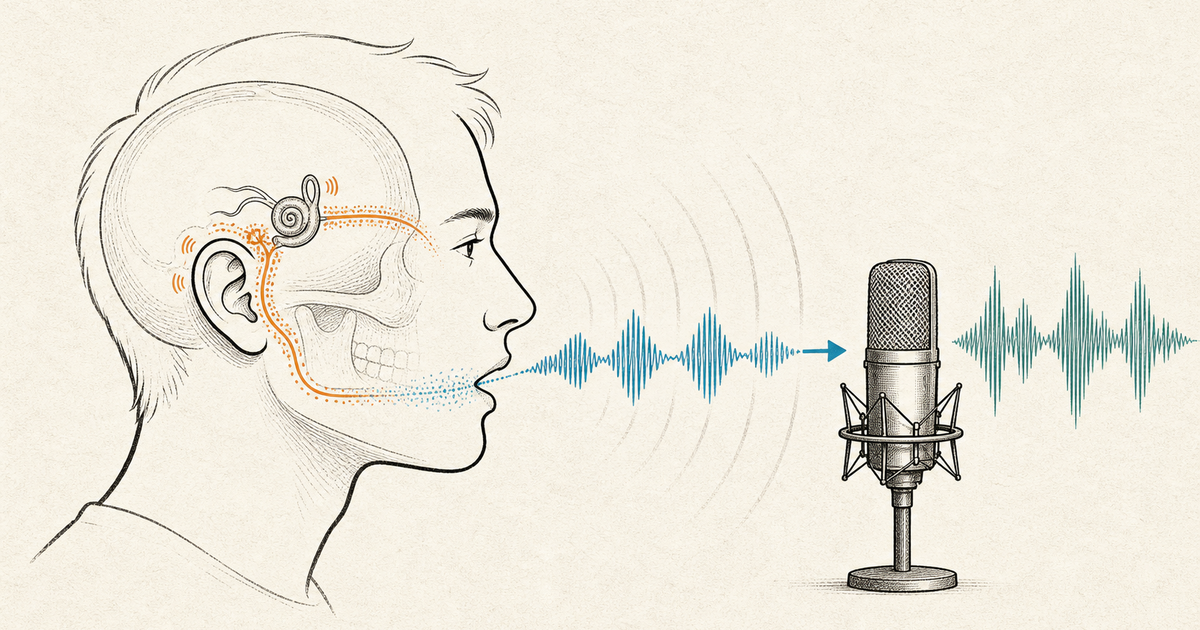
There’s a physical reason recordings can sound unfamiliar: hearing yourself while speaking includes bone-conducted vibration as well as sound through the air. Research on recognizing your own voice examines how bone conduction changes that experience. Our guide to why your recorded voice sounds different explores it further.
Try a short recording, speak normally, and focus on whether the words preserve what you meant. A journal entry doesn’t need a broadcaster’s delivery.
Check privacy before choosing an app
Ask whether recordings stay on your device, whether transcription uses cloud services, what is retained, and how you can delete entries. Audio retention and cloud processing are separate questions.
In Lound, you can choose to save audio on your device for playback or discard it after processing. Transcription and AI require cloud services. The free plan provides a transcript after recording and keyword search; Premium adds English live transcription and search by meaning. You can also type entries.
Read the privacy policy before including sensitive material. Record only the detail needed for your purpose, particularly when describing someone else’s private life.
Build around a reason to return
You can journal after an event or use a repeatable cue, such as finishing work. Daily recording is optional. After a gap, begin with the next entry rather than making yourself reconstruct missed days.
If the routine keeps falling apart, identify which part of journaling you avoid. Changing the prompt, length, or setting may be more useful than adding reminders.
For today, record one event, give it a title you could find again, and decide whether there is a reason to revisit it. When that reason arrives, compare what you expected with what happened.
Questions people ask
What is voice journaling?
Voice journaling means recording a personal reflection instead of, or alongside, writing it. You can keep the audio, create a transcript, or use an app that organizes the entry.
What should I say in my first voice journal?
Describe one recent event, what you currently think or feel about it, and anything you want to revisit. You don't need to summarize your whole day.
Do I need a special app to voice journal?
No. An ordinary voice recorder is enough to begin. A journal app can add transcription, summaries, and ways to search, depending on its features and plan.
Does Lound keep my audio?
You can choose to retain recordings on your device for playback or discard them after processing. Transcription and AI use cloud services; check the privacy policy before recording sensitive information.
How often should I voice journal?
Use a frequency that serves your purpose. You can record after a meaningful event or use a repeatable cue. A missed day doesn't require catching up.