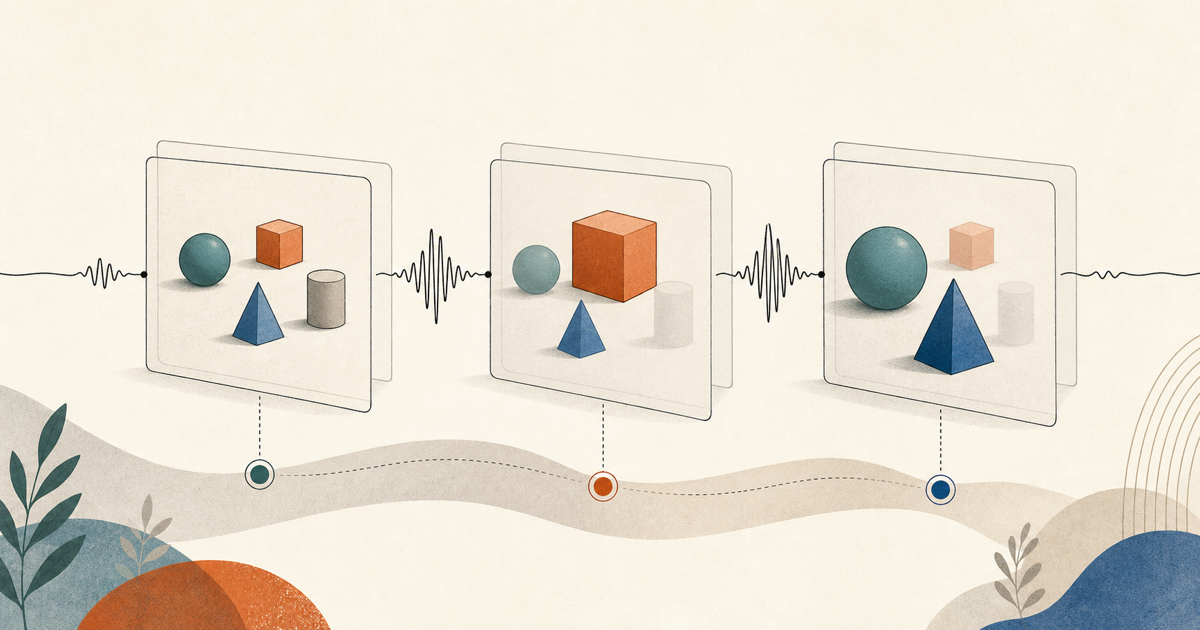
The Listener Changes the Story You Remember
We tune stories to fit listeners, and that tuning can alter later recall. A private first telling gives your memory an audience-free baseline.

The listener changes the story you tell, and sometimes the story you later remember. People naturally adjust detail, tone, and judgment to fit an audience. Research calls this audience tuning. Afterward, recall can lean toward the version that created a sense of shared understanding.
A private first telling is useful because it preserves the account before your manager, friend, family, or followers give it a social job to do.
Watch one event become three stories
A project launch goes badly.
You tell your manager:
The handoff failed because ownership changed twice and nobody updated the checklist.
You tell a close friend:
I felt exposed. Everyone looked at me when the numbers did not load.
You post publicly:
Launch days always teach you what the process hid.
All three versions can be honest. Each selects different evidence. The manager gets causes, the friend gets emotion, and the public gets a clean lesson. Repetition then gives one version more rehearsal than the others.
Research found that the tailored version can stick
In a set of experiments on audience tuning and memory, participants described a person for an audience known to hold a positive or negative view. Their later memories shifted toward the audience-shaped description, especially when the exchange created a sense of shared reality.
A 2025 study with 1,070 participants found that audience-congruent memory bias persisted even when researchers accounted for the communicator’s own initial judgment. A broader review of conversational remembering also documents how social sharing can reshape memory through audience tuning, information sampling, and repeated retrieval.
The finding has limits. Communication changes which parts get selected and practiced, and that selection can influence later access. The studies do not show that every conversation rewrites the past or that an audience can implant any story at will.
Every audience creates a different omission
Audience tuning matters most when the omitted material is important.
- At work, you may remove anger to sound credible.
- With a protective friend, you may remove your own contribution to the conflict.
- With family, you may soften the problem to prevent worry.
- Online, you may compress uncertainty into a lesson worth posting.
That is one reason retelling can change memory even when nobody intends to distort anything. A polished story gets easier to retrieve than the untidy event.
Record the private version before translation
For an event you expect to discuss repeatedly, make a two-minute private record first:
- What happened in observable order?
- Which words or actions do I remember clearly?
- What am I uncertain about?
- What did I feel before anyone reacted to my account?
- What meaning am I adding now?
Keep the uncertainty. “I think she rolled her eyes, but I was looking at my notes” is more useful than a clean accusation your memory may later treat as settled fact.
This approach pairs well with capturing facts before a story hardens. It also makes a voice note after a hard conversation more valuable because the first recording remains available beside later interpretations.
Private speech removes one source of pressure
A private voice journal still has an audience: you. You may minimize, perform, or search for a neat ending even when nobody else will hear it.
But privacy removes the immediate need to reassure a parent, impress a colleague, entertain a follower, or persuade a friend. That makes private reflection on hard days a useful baseline, not a guarantee of perfect memory.
When your later versions disagree, do not force them into one official story. Ask what each audience made easier to say and what each made easier to leave out. The differences contain information too.
Questions people ask
Why does my story change depending on who is listening?
People naturally select words, details, and emphasis for an audience. Research on audience tuning shows that the tailored version can also influence later memory.
Does changing a story for an audience mean I am lying?
Usually no. Audience tuning is a normal communication process, but each version highlights some details and leaves others quiet.
How can I preserve my first memory of an event?
Record a private account before discussing the event widely, and label facts, uncertainties, and later interpretations separately.