Can an AI Conversation Change Your Memory?
An AI can alter later recall when it introduces or reinforces details. Record your account first, then keep AI interpretation separate.
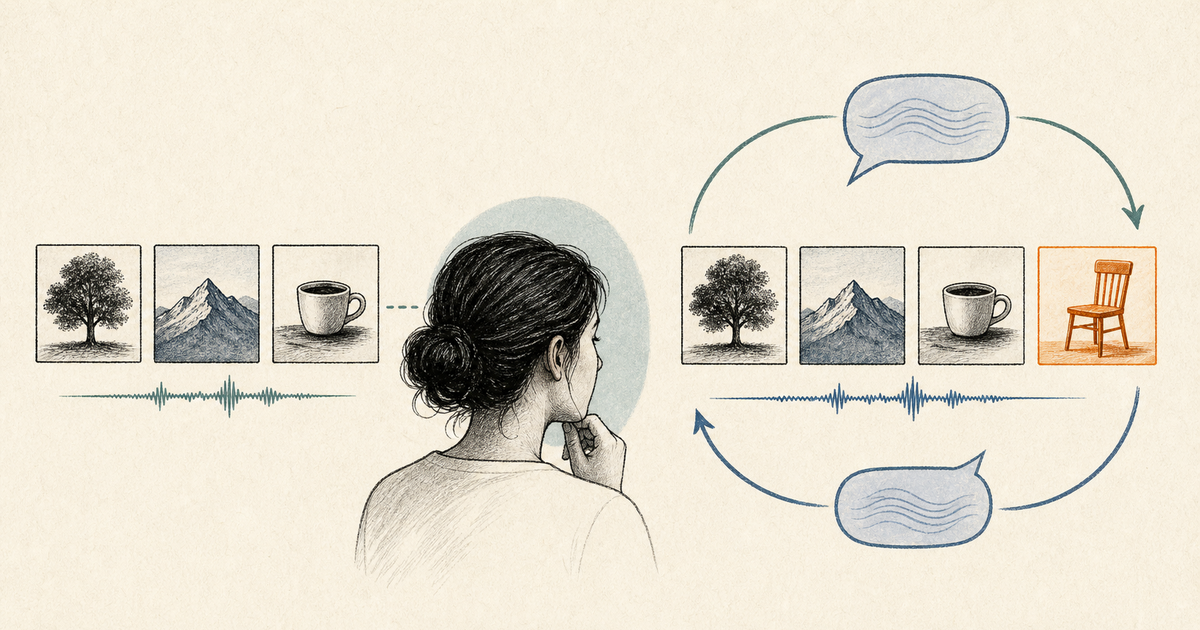
An AI conversation can influence what you later remember if it introduces a detail, embeds an assumption in a question, or confidently confirms an incorrect answer. Human memory is reconstructive, so later information can become mixed with the original event.
This does not mean every chatbot creates false memories. The strongest direct evidence comes from a controlled witness-interview study built to test misleading questions. The practical lesson for journaling is clear: preserve your account before inviting an AI to interpret it.
A question can contain an answer you never gave
Consider two prompts:
“What happened after your manager closed the door?”
“What happened next?”
The first question quietly asserts that the manager closed the door. If that detail was never in your account, answering the question can still make the premise feel familiar later.
Psychologists have studied this broader misinformation effect for decades. A recent experiment on warnings and misinformation describes the robust finding that information presented after an event can impair memory for the original event.
Conversation adds repetition and social feedback, two features that can make a suggestion feel more established.
What the AI study actually found
In a 2024 preprint, researchers showed participants a silent crime video and interviewed them using different methods. The generative-chatbot condition produced more immediate false memories than the control and survey conditions, and some errors persisted a week later.
The chatbot was intentionally given misleading questions and could personalize follow-ups. That design matters. It shows a risk under adversarial interview conditions, not a rate you can apply to a supportive journal chat.
Peer-reviewed research also finds that social interaction can induce false memories, even without someone explicitly supplying misinformation. Other people’s confidence and recall can shape your own reconstruction.
AI does not need intention to create the same problem. Fluency, repetition, and agreement are enough to blur where a detail came from.
Keep the first account uncontaminated
Before asking for themes, causes, or advice, make a first-pass record with no AI follow-up.
Use three labels:
- Observed: what you directly saw, heard, read, or did
- Inferred: what you think it meant
- Unknown: what you cannot currently verify
This extends the method for recording an event before retelling changes it. The first account will not be perfect, but it gives you a dated source that later interpretations cannot silently overwrite.
Ask AI questions that do not smuggle in facts
Useful prompts leave room for absence and uncertainty:
- “Which details in my account are observations, and which are interpretations?”
- “What questions can I ask without assuming a motive?”
- “Quote the exact sentence supporting each theme.”
- “Which parts of this account remain ambiguous?”
- “What did I not say? Do not fill it in.”
Avoid prompts such as “Why was she manipulating me?” unless manipulation is already established. Ask “What are several explanations consistent with the account?” and require evidence for each one.
A useful AI journal should sometimes disagree by pointing out unsupported certainty. It should not manufacture a more dramatic story.
Preserve provenance, not just prose
Provenance means knowing where each claim came from.
For an AI-assisted entry, keep:
- the original recording or transcript
- the AI’s questions
- your answers
- the generated summary or interpretation
- any later correction
That record lets you distinguish “I said this” from “the AI suggested this” and “I concluded this later.” A prediction logged before an outcome serves the same purpose. It gives you a reference point before hindsight edits the story.
Use AI after capture, not inside the memory
AI can help search entries, compare accounts, surface contradictions, and suggest questions. Those jobs are useful because the source remains available for inspection.
Treat any generated narrative as a layer above the record. Keep it editable, attributable, and easy to compare with your own words. The goal is not to freeze memory into a courtroom transcript. It is to stop a helpful-sounding suggestion from quietly becoming something you believe you witnessed.
Questions people ask
Can talking to AI create a false memory?
It can contribute when the AI introduces false details through leading questions or confidently reinforces an incorrect answer. Evidence comes from controlled witness-interview research, not from every ordinary AI conversation.
How can I use AI without changing my journal account?
Record a first account before asking AI questions, label observation separately from interpretation, and preserve the original transcript so later suggestions can be checked against it.
What should an AI ask about a memory?
Open questions such as 'What do you remember next?' are safer than questions that assume a detail, motive, or cause. The AI should also state when a detail came from its suggestion rather than from you.