Why Reading Your Old Journal Makes You Cringe
An old entry can sound painfully certain. Learn how to reread it with the facts you had then, check what happened, and add a useful update.
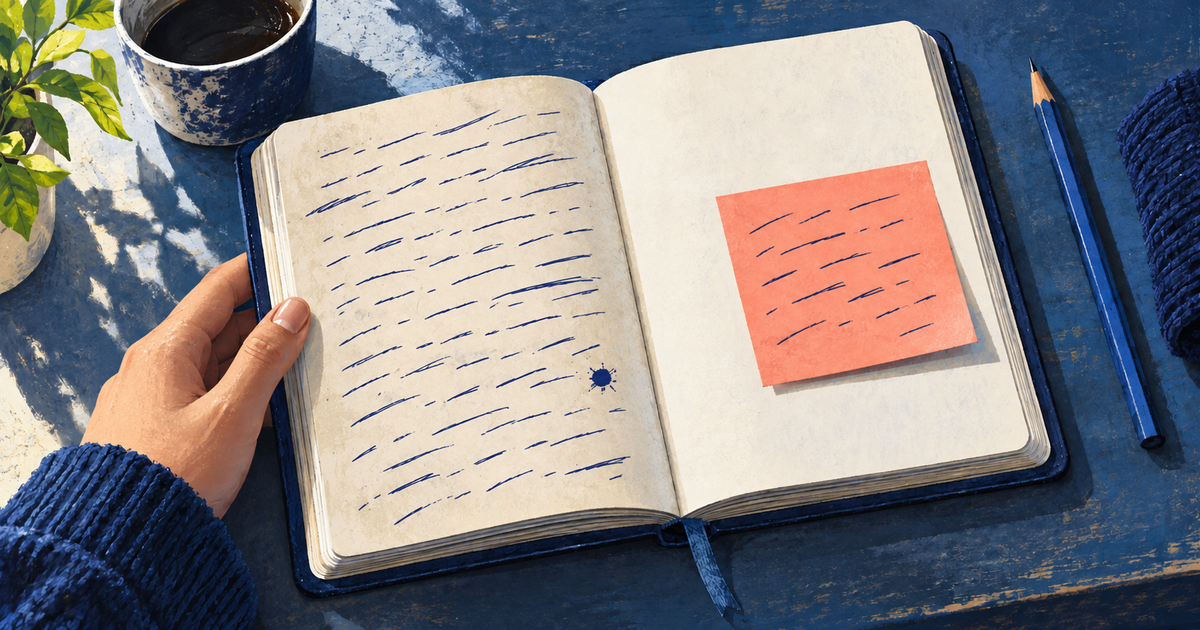
An old journal entry can make you wince because it preserves your words before you knew how the story turned out. Read it as an account of what you knew then. Keep the original, and add a dated note about what you learned later. That gives you a record of change without asking past you to sound like present you.
Say you find this line after an awkward meeting: “I rambled. They probably regret putting me on the project.” You may dislike the certainty of it now. Before deciding the whole entry was foolish, ask what actually happened in the room and what evidence arrived afterward.
Why does an old entry sound so different?
A journal captures a particular hour, sometimes the least flattering hour of the week. It doesn’t include tomorrow’s reply, the conversation you were too tired to describe, or the fact that you had slept badly. The words can look more settled on a page than the thought felt while you were writing them.
Knowing the outcome changes the way people judge what was knowable earlier. In two experiments involving 226 participants, people predicted outcomes before learning them. Afterward, the outcome affected how certain they remembered being and how strong they remembered their reasons, even though the researchers knew what they had predicted. The experiment did not ask anyone to reread a diary. It does show why a dated account is useful when hindsight starts making the past look obvious.
Sometimes the discomfort is simpler: you no longer talk like that. A dramatic sentence, an old ambition, or a joke can sound strange without being evidence that your former self was wrong about everything. Cringe does not need a diagnosis or a mandatory lesson.
What should you look for on the first read?
Choose one ordinary entry, preferably not your most painful one. Read it once for three kinds of information:
- What happened? “I lost my place in the presentation.”
- What did I infer? “The team must regret choosing me.”
- What didn’t I know yet? “I hadn’t heard anyone’s response.”
The second line may have been a real fear without being a fact about the team. Keeping that distinction makes the entry more informative. You can disagree with the inference while still understanding why it felt plausible.
That small distinction is useful for decisions too. A prediction recorded before an outcome can show both what you expected and how uncertain you were. The point is to learn from the difference, not to keep score against yourself.
How do you add what you know now?
Leave the earlier line where it is. Put the update beneath it with today’s date, or make a new entry that names the earlier one:
I was embarrassed after the meeting, and I treated that feeling as evidence that the team had lost confidence in me. Two colleagues later asked for the slides and gave useful questions. That doesn’t tell me exactly what everyone thought. I still want to prepare the data section more clearly next time.
The update doesn’t force a happy ending. It keeps the concern about the presentation, corrects the unsupported conclusion about other people’s minds, and identifies one thing to do differently. If the outcome had been worse than expected, the same method would still let you ask what you could reasonably have seen at the time.
This is why an old entry can be more useful than a polished recap. You can compare a contemporaneous account with a later account instead of relying on memory alone. Our guide to how decisions look different afterward explores that problem further.
Can you get some distance without dismissing the feeling?
Try replacing “How could I have thought that?” with “What had I been told by that afternoon?” The first question invites a verdict. The second asks for evidence.
In three studies of reflection on negative memories, Ayduk and Kross found that people who spontaneously viewed an experience with more distance reported less immediate emotional reactivity. Their analysis linked that distance with making sense of the event rather than simply replaying its details. The work was about reflection on memories, not a controlled test of rereading journals. It supports being curious about your earlier context, without promising that every entry will feel better after you revisit it.
A separate 2024 experiment with university students compared compassionate letters to a past self with letters to a future self. The past-self letters were followed by a larger short-term drop in negative feelings. Participants wrote letters under study conditions; they did not reread old journal entries, and the result doesn’t establish a lasting benefit for this exercise. Still, writing one kind sentence in a new note may feel more natural than trying to correct every line of the old one.
What if rereading hurts more than it helps?
You don’t owe every entry a second visit. Some contain a loss, a frightening period, or private details about someone else. Choose what to open, what to leave closed, and whether the entry is appropriate to discuss with a person you trust.
If you notice yourself rereading the same painful paragraph just to judge it again, stop. A different day or a different entry may be more useful. Why journaling sometimes stops working includes ways to change the task when it becomes too demanding. Persistent distress deserves support from a qualified professional rather than a harder journaling assignment.
How do you do this in a voice journal?
The same approach works with audio or text. In Lound, a transcript makes the old words readable, and keyword search can help you find the entry. If you chose to keep the audio on your device, you can listen to it; you do not need playback to understand the entry. Lound’s AI summary and mood are interpretations, so return to your own words when a detail matters. You can record or type today’s update as a separate entry and name the older event so it is easy to find again.
An ordinary entry may be a better place to begin. Our piece on journaling when nothing happened shows the kind of everyday record that can become interesting later without requiring a dramatic insight. Find one old entry you can read comfortably, ask what was knowable on that date, and leave it with a dated response if you have something new to add.
Questions people ask
Why do my old journal entries make me cringe?
You are reading a moment written with less information than you have now. The wording, fears, and certainty may feel unfamiliar. That reaction alone does not tell you whether your past concern was reasonable.
Should I edit an old journal entry after I learn what happened?
Keep the original if you want to see what you believed at the time. Add a dated note or new entry with what happened and what you understand differently now.
How do I reread an old journal without judging myself?
Start with one manageable entry. Separate the event, your interpretation, and what was still unknown. Then compare it with later evidence instead of grading your past self from the outcome alone.
Do I have to reread a painful journal entry?
No. You can leave it alone, choose a less intense entry, or stop when rereading becomes distressing or repetitive. A journal is available to you; it is not an assignment.